
The Life of Chuck is a Stephen King’s novella that unfolds in a three-chapter, reverse-order structure. Given director Mike Flanagan’s affinity for non-linear storytelling (as demonstrated in all his previous work, but specially in The Haunting of Bly Manor and Oculus), along with his fascination with philosophical and existential themes and his prior success with King’s Doctor Sleep, it’s easy to see why he was drawn to this material for his first venture outside the horror genre.
The anthology-like film begins with the chapter “Thanks, Chuck,” set in a world on the verge of collapse, where mysterious billboards appear with the message “39 Great Years! Thanks, Chuck!” No one knows who Chuck is or why the billboards are there. The palpable sense of dread in this chapter is so well-executed that one almost wishes Flanagan had pursued an M. Night Shyamalan-style apocalyptic thriller. However, the second chapter pivots to a completely different tone, focusing on Chuck as an accountant, played briefly by Tom Hiddleston. This chapter features a visually impressive dance sequence, but the story feels more suited to a TV commercial than a film, leaving the audience somewhat adrift.
The final chapter attempts to tie everything together, focusing on a younger Chuck and adding context to the earlier segments (though the first chapter’s ending already makes the twist fairly predictable). While this chapter works well on its own, with moments of humor and creativity, like a witty neighbor, a lively dance class, and Mark Hamill’s standout performance, it ultimately weakens the coherence of the previous acts. The themes introduced here make Chuck’s earlier decisions, particularly in chapter two, feel inconsistent. (Minor spoiler: wouldn’t it have made more sense for him to follow a dancing career instead of yielding to societal expectations enforced by Hamill’s character?)
Visually, the film is unexpectedly flat, lacking the usual flair and sharp editing that Flanagan is known for. While the dance sequence stands out, the film is burdened by drawn-out philosophical discussions that feel shallow rather than profound, with one particular scene involving a comparison between the universe’s timeline and a calendar year, feeling especially indulgent. Overall, The Life of Chuck aspires to philosophical depth but struggles to unify its fragmented structure and lofty ideas into a cohesive whole.
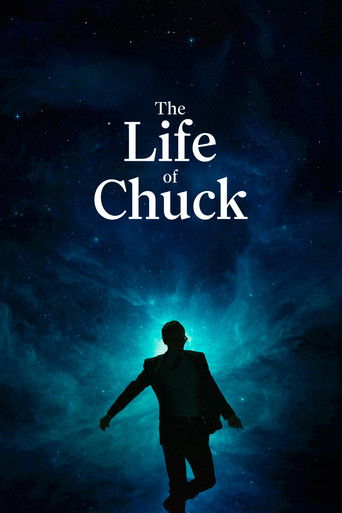
Still courtesy of Elevation Pictures
- 1Sentimental Value
- 2Hamnet
- 3One Battle After Another
- 4Ne Zha 2
- 5Blue Moon
- 164The Life of Chuck#164 of 256
- 1Conclave
- 2Better Man
- 3The Substance
- 4The Assessment
- 5Queer
- 35The Life of Chuck#35 of 50
- Where to watch
 Prime Video
- Where to watch
- Prime Video
 Play trailer


- Original title
- The Life of Chuck
- Director
- Mike Flanagan
- Cast
- Tom Hiddleston, Benjamin Pajak, Nick Offerman, Chiwetel Ejiofor, Karen Gillan, Mia Sara, Mark Hamill, Annalise Basso
- Rated
- PG
- Screenwriter
- Stephen King, Mike Flanagan
- Composer
- Andrew Grush, Taylor Stewart
- Cinematography
- Eben Bolter
- Editor
- Mike Flanagan
- Country

- Language
- English
- Budget
- $25 million
- Box office
- $19.701 million
- Distributor (CA)
- Elevation Pictures