
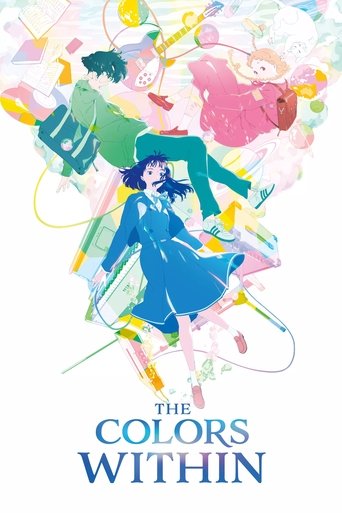
2025 is just beginning, but it’s hard to imagine I’ll watch anything throughout the year as serene and delicate as The Colors Within. This Japanese animation, directed by Naoko Yamada, is a heartfelt exploration of friendship, self-discovery, and, surprisingly, what it actually means to love God, all told through a simple coming-of-age story about a high school girl with synesthesia, an ability to perceive people’s emotions as colors.
Totsuko, the protagonist, is captivated by the unique hues of her classmate, Kimi, and later Rui, a boy she encounters in a used bookstore. Her fascination with their colors gives her the courage to connect with them, and when she discovers their mutual love for music, she suggests forming a band. However, the strict rules of her Catholic high school force them to practice in secret, leading to poignant moments of reflection about individuality, faith, and creativity.
Told through a watercolor aesthetic that perfectly complements its dreamlike and introspective tone, The Colors Within eschews traditional conflict and plot for a quieter approach. The story focuses on the characters as they discover themselves, develop their passion for music, and form a deep bond. It feels consistently sweet and tender, embracing a reflective pace that invites the audience to simply exist alongside these young characters.
One of the most intriguing aspects of the film is its exploration of morality and religion. Totsuko is driven by the rules of her faith and school, but the film gently questions whether following rules blindly equates to being “good.” A pivotal moment comes when a Sister reprimands Totsuko for lying but acknowledges she did it out of love for a friend. This sparks a subtle conversation about the nature of goodness and whether love can justify bending the rules. While this exploration is thought-provoking, it remains surface-level, with even the Sister appearing constrained by the very rules she upholds. As a result, the message doesn’t quite reach the profound depths it seems to aim for.
The film also doesn’t quite reach its potential in exploring the backstory of the three friends. While the idea of children bonding over music and shared hardships is compelling, their individual struggles feel too understated or culturally specific to fully resonate with non-Japanese audiences. This limits the emotional impact of key moments, particularly toward the end. Similarly, the music performances, though pleasant, lack the transcendent, show-stopping quality found in films like Sing Street. Even the synesthetic colors, despite being central to the premise, aren’t as creatively integrated into the visuals as one might hope, especially during the musical sequences. The animation remains beautiful in its simplicity, and the soothing score adds to the film’s overall charm, but there’s a sense of untapped potential in how these elements could have been more dynamic.
Still, The Colors Within is a lovely and heartfelt film. Watching these young characters find their voices and form meaningful connections through music is a rewarding experience, even if their personalities and stories may not fully connect on a universal level. It’s a serene, soothing journey, perfect for those who appreciate quiet, introspective storytelling.
- 1Dune: Part Two
- 2Conclave
- 3Better Man
- 4The Substance
- 5Challengers
- 67The Colors Within#67 of 110
- Where to watch
- Rent or buy at Apple TV Store, YouTube
- Where to watch
- Not available for streaming
 Play trailer


- Original title
- きみの色
- Director
- Naoko Yamada
- Cast
- Sayu Suzukawa, Akari Takaishi, Taisei Kido, Yui Aragaki, Aoi Yuuki, Yasuko, Minako Kotobuki, Keiko Toda
- Rated
- PG
- Screenwriter
- Reiko Yoshida, Naoko Yamada
- Composer
- Kensuke Ushio
- Cinematography
- Yoshimitsu Tomita, Akiyo Yamaura, Naoki Takahashi
- Editor
- Kiyoshi Hirose
- Country

- Language
- Japanese
- Box office
- $2.486 million