
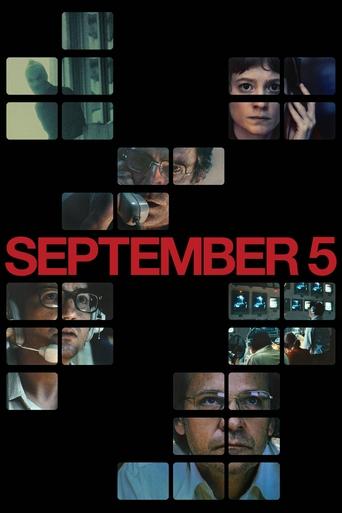
On September 5, 1972, during the Munich Olympics, eight Palestinian militants from Black September infiltrated the Olympic Village, taking eleven Israeli athletes hostage in a violent bid to secure the release of political prisoners. This led to a tense, 20-hour standoff that ended in tragedy. Though much of the violence occurred off-camera, the event unfolded in real-time on television, making it one of the first acts of terrorism witnessed by a global audience. September 5, directed by Tim Fehlbaum, takes an interesting angle by focusing on the American sports broadcasting crew that covered the crisis, showing how they scrambled to report an unprecedented and horrifying event.
There’s a lot of potential in this premise, how an unprepared sports crew navigates the ethical and logistical challenges of covering a live crisis. The film briefly touches on these ideas but never delves deeply into them. Much like the crew it follows, the film seems more concerned with chronicling the event itself than exploring its deeper implications.
At just 94 minutes, the pacing is brisk, and the film is never boring, but its shallow execution undermines the gravity of the story. It feels more like a rushed reenactment than a thoughtful examination of the stakes or the moral dilemmas at play.
The recreation of the 1970s broadcast environment is one of the film’s stronger aspects. From the period equipment to the technical choreography of live television, lever-pulling, video fading, satellite juggling, there’s an authenticity that pulls you in. However, while these details are impressive, they aren’t enough to sustain the film. The cinematography is flat and overly reliant on close-ups, giving the movie a generic TV-movie feel that makes it seem too small for such a dramatic real-life event.
Where September 5 falters most is in its lack of emotional depth. The characters, while competently portrayed, feel like placeholders rather than fully realized people. They react to the unfolding events, but their personal stakes and conflicts are barely explored. Given the unique angle of focusing on a sports crew, this is particularly disappointing. Instead of feeling out of their depth, they come across as oddly composed and competent, more like seasoned crisis reporters than people thrust into an unimaginable situation.
Even the film’s most thought-provoking moment, when the live broadcast inadvertently tips off the terrorists, is handled in a fleeting, almost dismissive way. The ethical implications of live reporting, what it means to prioritize the story over human lives, are barely touched on. The film plays it safe, offering a surface-level recounting of events without ever exploring their emotional or moral toll.
In the end, September 5 is a watchable but uninspired history lesson. It offers a decent primer on the Munich hostage crisis for those unfamiliar with the events, and it also gives a solid glimpse into how TV in the ’70s worked, with channels sharing satellites and the technical choreography of live broadcasts. However, it fails to leave a lasting impact. The premise deserved more than this procedural retelling, and the lack of ambition ultimately prevents the film from being as powerful or memorable as it could have been.
- 1Dune: Part Two
- 2Conclave
- 3Better Man
- 4The Substance
- 5Challengers
- 80September 5#80 of 110
- Where to watch
- Rent or buy at Apple TV Store, YouTube, Amazon Video
- Where to watch
 Paramount Plus
 Play trailer


- Original title
- September 5
- Director
- Tim Fehlbaum
- Cast
- Peter Sarsgaard, John Magaro, Ben Chaplin, Leonie Benesch, Zinedine Soualem, Georgina Rich, Corey Johnson, Marcus Rutherford
- Rated
- PG
- Screenwriter
- Tim Fehlbaum, Moritz Binder, Alex David
- Composer
- Lorenz Dangel
- Cinematography
- Markus Förderer
- Editor
- Hansjörg Weißbrich
- Country


- Language
- English
- Box office
- 852000