
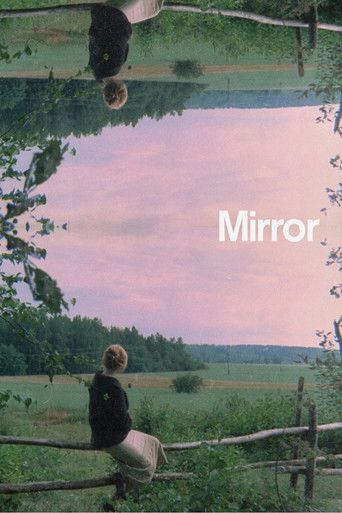
In Mirror, Andrei Tarkovsky explores his past through a semi-autobiographical lens, blending childhood memories, dreams, and historical reflections into a meditation on regret and guilt. The film centers on Alexei, a stand-in for the director, and unfolds in a way that mirrors the fragmented, nonlinear nature of memory. Scenes are presented out of chronological order, and at times, the same actor portrays different characters. For example, because his wife reminds him of his mother, Alexei’s mother is played by the same actress who portrays his wife. The result is a film that can feel abstract and sometimes disconnected, filled with moments that don’t seem relevant to the plot or its themes, like a memory of spilled milk. But in Tarkovsky’s world, such details are integral to his broader exploration of memory itself.
In a way, the film can be described as Tarkovsky’s All That Jazz. If in that film, Bob Fosse re-examines the futility of his life, Tarkovsky focuses on his guilt, especially about repeating his father’s mistake of abandonment with his son. Growing older and seeing his mother as a person who made many sacrifices to raise him and his brother, Alexei feels that he is now giving his son the same feeling of abandonment his father gave him, perpetuating a painful cycle of broken connections.
Tarkovsky excels in how he frames the story. Much of the film feels like stepping into someone else’s dream, full of symbolic images that you might understand on a gut level but struggle to articulate. You feel like you’re getting to know the director through his memories. It’s a work that invites multiple viewings to unravel its mysteries. Some viewers may find the film’s ambiguity rewarding, seeing it as a reflection of life’s own chaotic beauty. Yet, after multiple viewings, you might still find yourself questioning whether Tarkovsky really knows what he’s trying to say.
Unlike other directors who later adopted his “dream-like” approach, such as Terrence Malick in The Thin Red Line or Lars von Trier in Melancholia, Tarkovsky seems content with presentation alone, without needing to offer any clear meaning. It’s as if he’s throwing out thoughts without attempting to make sense of them, almost as though he’s avoiding the deeper reflection that would bring cohesion. With this, we’re left with a lot of scenes that don’t add anything substantial.
Though Mirror has influenced generations of filmmakers and remains a landmark in arthouse cinema, it risks feeling like an empty experience. The imagery may captivate you while watching, and you might even remember specific visuals that felt transformative. However, once the film ends, there’s little that lingers beyond the aesthetics. Unlike some of Tarkovsky’s other works that engage more directly with philosophical ideas, Mirror feels like an experiment in style, a beautiful, immersive experience, but one that may fade from memory without leaving a lasting impact.
For those willing to engage with its unique approach, Mirror offers a meditative look into memory and history through one of cinema’s great visionaries. But as powerful as the film’s visuals and style are, it ultimately feels like it’s grasping at something profound without ever fully reaching it.
- 1One Flew Over the Cuckoo's Nest
- 2Dersu Uzala
- 3Jaws
- 4Nashville
- 5Manila in the Claws of Light
- 41Mirror#41 of 51
- Where to watch
- Rent or buy at Apple TV Store, Google Play Movies, YouTube
- Where to watch
- Not available for streaming
 Play trailer


- Original title
- Зеркало
- Director
- Andrei Tarkovsky
- Cast
- Margarita Terekhova, Ignat Daniltsev, Larisa Tarkovskaya, Alla Demidova, Anatoliy Solonitsyn, Mykola Hrynko, Tamara Ogorodnikova, Yuriy Nazarov
- Rated
- NR
- Screenwriter
- Aleksandr Misharin, Andrei Tarkovsky
- Composer
- Eduard Artemyev
- Cinematography
- Georgi Rerberg, Yuri Potapov
- Editor
- Lyudmila Feiginova
- Country

- Language
- Russian
- Budget
- 825000
- Box office
- 124367