
OVERVIEW
In Two Prosecutors, Sergei Loznitsa returns to Stalinist Russia for the story of Alexander Kornev, a newly appointed prosecutor who finds a prisoner’s letter accusing prison officials of torture and, confronted with one of his first real tests in the role, is determined to do his job properly. Set in 1937, during the Great Purge, the film follows his movement through the Soviet chain of command, where he gradually comes to see how deeply corrupted the system is. Based on a novella by Georgy Demidov, the film traces how the system does not fail justice by accident, but uses authority, fear, and procedure to suppress it.
BACKGROUND
Unfortunately, Georgy Demidov knew this world from the inside. A Soviet physicist who spent fourteen years in the gulag as a political prisoner, he wrote the novella in 1969 from direct knowledge not only of the system’s brutality, but of the cold efficiency with which it silenced dissent and protected itself. It was suppressed for decades and published only long after his death. That material is a natural fit for Sergei Loznitsa, whose documentaries have long circled Soviet history and institutional violence. Two Prosecutors marks his first narrative film in seven years, and he has described it less as a return to fiction than as a continuation of the same ideas, particularly those behind 2018’s The Trial.
EXECUTION
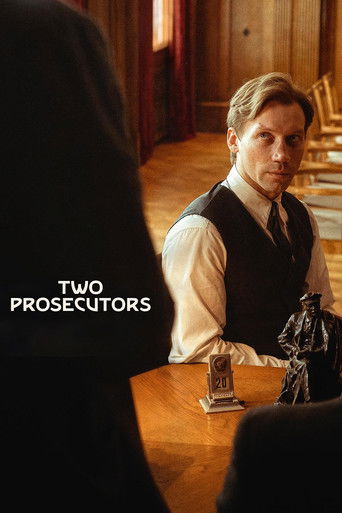
The whole experience is suffocating by design, meant to make the viewer feel the same confinement and oppression that shape Kornev’s journey. Shot in the nearly square 1.37:1 aspect ratio and covered in a drained gray palette, the film rarely gives him a moment when he is not boxed in by walls, corridors, doors, or desks. He is also often pushed to the edge of the frame or looked down upon, which makes him seem smaller and less imposing despite his fierce determination.
Contributing even more to that oppression is the film’s extremely patient pacing. Loznitsa uses long stretches in offices, waiting rooms, and hallways to show how the passage of time is itself part of the system’s pressure. The whole opening movement, from the introduction of the prison to Stepniak’s letter making its way out and Kornev’s conversation with him, takes around 70 minutes, essentially a full first act built around procedural movement that could easily have been conveyed in a third of the time and still felt slow.
The approach is undeniably effective and, like classics of slow cinema such as Jeanne Dielman, 23 quai du Commerce, 1080 Bruxelles, keeps the viewer attentive and unsettled by the smallest details. There is also a strong visual rhyme between the opening and closing, and a shot of Kornev in a waiting room that slowly empties around him is especially elegant. At the same time, the film’s rigor makes the experience laborious, and at times even dull. The sparse score occasionally injects some life, and there is some dry humor that works well, but it appears too rarely.
Aleksandr Kuznetsov is very effective at letting us understand Kornev. His intense stare and the actor’s repaired nose hint at a life filled with hardship, while precise movements reveal a lot about his principles. The way he barely changes his expression until a later moment when he is drunk and smiling openly helps sketch a man who has also spent a long time holding himself in check. Even so, the film’s refusal to show more of his personal life, his home, or even a private conversation, anything outside the official spaces, keeps the emotional impact somewhat muted. For a film and a character that stay so controlled for so long, a stronger break in the final minutes might have made the experience even more devastating.
AFTERTASTE
Two Prosecutors is so controlled, so deliberate in the way it uses space, time, and composition to wear both Kornev and the viewer down, that its oppressive effect cannot be denied. What makes the film admirable, though, is also what keeps it at a distance. The monotony is clearly part of the design, but it also mutes the force of the final stretch, which arrives with less devastation than the material seems to promise. Still, Loznitsa’s achievement is clear: he turns bureaucracy itself into a form of violence, exposing a world in which every official step exists not to correct injustice, but to protect it.
- 1Everytime
- 2Hadestown: The Musical
- 3Tuner
- 4Minotaur
- 5You Can See Everything
- 71Two Prosecutors#71 of 218
- 1Sentimental Value
- 2Hamnet
- 3Blue Moon
- 4Sirāt
- 5Tuner
- 32Two Prosecutors#32 of 74
- 1Sentimental Value
- 2Sirāt
- 3The Plague
- 4Arco
- 5Resurrection
- 12Two Prosecutors#12 of 28
- Where to watch
- Rent or buy at Apple TV Store
- Where to watch
 Telecine
 Play trailer


- Original title
- Deux procureurs
- Director
- Sergei Loznitsa
- Cast
- Aleksandr Kuznetsov, Aleksandr Filippenko, Anatoliy Belyy, Andris Keišs, Vytautas Kaniušonis, Valentin Novopolskij, Ivgeny Terletsky, Orests Paško
- Screenwriter
- Sergei Loznitsa
- Composer
- Christiaan Verbeek
- Cinematography
- Oleg Mutu
- Editor
- Danielius Kokanauskis
- Country




- Language
- French