
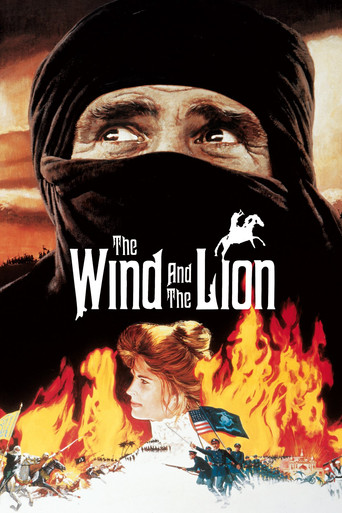
One of Hollywood’s favorite patterns is to chase the success of cultural phenomenons, and after Lawrence of Arabia took off, studios were quick to try to capitalize on it. Enter The Wind and the Lion, a 1975 release clearly inspired by the epic scope of Lawrence. With a sweeping, adventurous score by Jerry Goldsmith, it sets out to capture that same grandeur. But while the music brings the spirit of adventure and grandeur, it can only do so much for a movie that’s oddly uneven.
Directed by John Milius, The Wind and the Lion is loosely based on the 1904 kidnapping of American Eden Pedecaris (Candice Bergen) and her children by Moroccan rebel Mulai Ahmed er Raisuli (Sean Connery). Raisuli’s has a secret agenda: he’s after ransom, but also the political disruption it might cause, making a statement about Morocco’s instability amid Western interference. This clash between Raisuli and the forces of American imperialism, personified by Brian Keith’s take on President Theodore Roosevelt, drives the film.
The film is a fitting nod to New Hollywood’s boldness, with grand visuals and a rich sense of place. From the opening kidnapping sequence, which is unexpectedly violent, the movie sets Raisuli up as a formidable, even brutal, leader. Yet, within minutes, it shifts him from dangerous rebel to a cartoonish villain that belongs more to the Tintin universe than a serious drama. Connery does his best to balance Raisuli’s cartoonish traits with charisma and commanding tone, but the film would be more compelling had it kept his character’s darkness intact.
The movie is at its best on the scenes between Pedecaris and Raisuli, and during its action scenes, which are impressively executed, even if the characters’ motivations start to feel muddled. Roosevelt, as portrayed by Keith, brings a touch of satirical patriotism to the American viewpoint, yet his scenes begin to drag, diminishing the narrative’s focus. By the time the final battle rolls around, technical skill aside, it’s hard to feel truly invested in the stakes.
Visually, The Wind and the Lion is a treat, shot on location in Spain and full of immersive, sweeping desert landscapes. Goldsmith’s score was rightfully Oscar-nominated, its grand orchestration perfectly suiting the epic tone. Beyond the technical aspects, the script includes some memorable lines, Roosevelt’s humorous argument for the bear over the eagle as America’s symbol, for instance, and Raisuli’s powerful parting words.
For fans of eastern adventures and political intrigue, The Wind and the Lion offers spectacle, but ultimately, it’s a flawed epic. Despite impressive technical achievements, it misses the emotional depth and daring complexity that could have made it resonate more deeply.
- 1One Flew Over the Cuckoo's Nest
- 2Dersu Uzala
- 3Jaws
- 4Nashville
- 5Manila in the Claws of Light
- 42The Wind and the Lion#42 of 51
- Where to watch
- Rent or buy at Apple TV Store, Google Play Movies, YouTube, Amazon Video
- Where to watch
- Not available for streaming
 Play trailer


- Original title
- The Wind and the Lion
- Director
- John Milius
- Cast
- Sean Connery, Candice Bergen, Brian Keith, John Huston, Geoffrey Lewis, Steve Kanaly, Vladek Sheybal, Nadim Sawalha
- Rated
- PG
- Screenwriter
- John Milius
- Composer
- Jerry Goldsmith
- Cinematography
- Billy Williams
- Editor
- Robert L. Wolfe
- Country

- Language
- English
- Budget
- $4.5 million
- Box office
- $9.2 million