
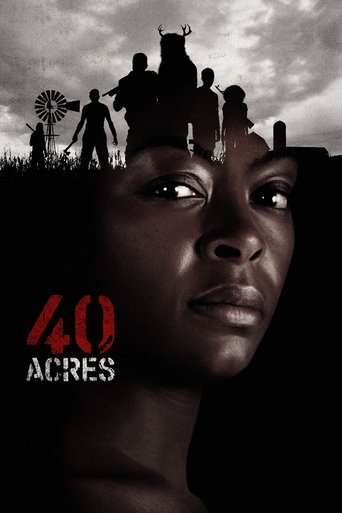
40 Acres, the first feature film directed by R.T. Thorne, takes place in ‘A Quiet Place‘-like post-apocalyptic future where food is scarce and survival is brutal. The story centers on the Freemans, a Black family living in isolation on a farm in Canada that despite societal collapse and a series of plagues, managed to survive by staying away from the remnants of civilization. However, they must constantly fend off a militia determined to take their land. The family’s survival is threatened not only by external forces but also by internal tensions, especially when Emanuel, the eldest son, forms a risky connection with a stranger he meets in the forest.
Thorne shows great promise when the movie enters action territory. The opening scene is particularly suspenseful and well-executed, with hints that the director may have taken inspiration from The Last of Us video-game in its tension-filled, dystopian atmosphere. When the action sequences hit, they are clever and full of suspense, especially in the film’s third act, where Thorne’s ability to craft tense battles shines through. The gunfire-lit scenes and knife fights are standout moments, proving the director has a strong eye for choreography. Unfortunately, the movie stumbles in between these moments, weighed down by slow pacing (specially in its first half) and a clunky structure divided into unnecessary chapters that disrupt the flow.
Character development is another area where 40 Acres falls short. While Deadwyler’s Hailey and O’Connor’s Emanuel are the most fleshed out, even their arcs lack depth and complexity. Hailey’s rigid belief in isolation is never fully examined, missing a key opportunity to explore whether her choices have hindered her children’s emotional development. Deadwyler tends to overact in critical moments, with exaggerated expressions that would benefit from more subtlety. The rest of the family is left largely unexplored, which causes the first half, focused on their dynamics, to drag. Several scenes feel unnecessary and, in retrospect, don’t make sense, particularly those involving the stranger girl Emanuel encounters. Additionally, a flashback meant to provide depth does little to enhance the story and instead disrupts the pacing further.
Also, the cannibalistic villains are generic, one-dimensional, and make baffling decisions that diminish any sense of danger. On two occasions, they opt to eat their captive, only to give them a chance to fight back. Couldn’t they have waited until they finally won? It’s not as though they are starving, as we see them with barrels of food. These illogical moments strip the antagonists of any real menace.
Ultimately, 40 Acres is a frustrating experience. While its action scenes and final act are expertly crafted, 40 Acres is ultimately held back by underdeveloped characters, generic villains, and a lackluster exploration of its themes, leaving the story feeling incomplete. Unfortunately, the film’s casting of Black and Indigenous characters seems underutilized, as their cultural backgrounds aren’t meaningfully integrated into the narrative, reducing what could have been a powerful metaphor to a surface-level detail. Thorne shows potential as a director, especially in his handling of tense action sequences, but the film would have benefitted from a stronger script and tighter focus. Here’s hoping that his next project gives him the material to truly showcase his talents.
Still courtesy of Mongrel Media
- 1Sentimental Value
- 2Hamnet
- 3One Battle After Another
- 4Ne Zha 2
- 5Blue Moon
- 10340 Acres#103 of 256
- 1Conclave
- 2Better Man
- 3The Substance
- 4The Assessment
- 5Queer
- 1940 Acres#19 of 50
- Where to watch
 Crave
Crave- Where to watch
 Netflix
 Play trailer


- Original title
- 40 Acres
- Director
- R.T. Thorne
- Cast
- Danielle Deadwyler, Kataem O'Connor, Michael Greyeyes, Milcania Diaz-Rojas, Leenah Robinson, Jaeda LeBlanc, Haile Amare, Elizabeth Saunders
- Rated
- 14A
- Screenwriter
- R.T. Thorne, Lora Campbell, Glenn Taylor
- Composer
- Todor Kobakov
- Cinematography
- Jeremy Benning
- Editor
- Dev Singh, Sandy Pereira
- Country

- Language
- English
- Box office
- 754751
- Distributor (CA)
- Mongrel Media