
OVERVIEW
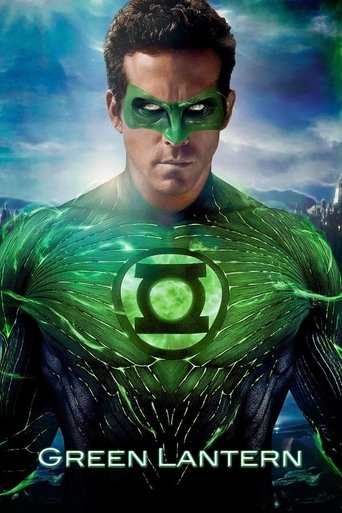
One of the biggest fumbles in Hollywood history, Green Lantern attempted to bring an ambitious comic book universe and its extensive mythology to life, only to spend most of its time stuck on Earth and end up as one of Warner Bros.’ most generic and forgettable superhero films. The film follows Hal Jordan (Ryan Reynolds), a reckless and arrogant test pilot who still carries the trauma of his father’s death and struggles to commit to anything, including his relationship with Carol Ferris (Blake Lively). His life is marked by unfulfilled potential and missed opportunities. That is, until a dying alien’s ring chooses him to join the Green Lantern Corps, an intergalactic organization tasked with protecting the universe, granting him special powers in the process. As the ancient cosmic threat known as Parallax threatens Earth, Hal must learn to overcome his fears and embrace his newfound responsibilities as a Green Lantern.
BACKGROUND
Green Lantern had been in development at Warner Bros. for years, even coming close to becoming a comedy starring Jack Black, before the studio settled on a more traditional superhero approach and hired Greg Berlanti to write and direct in 2007. An enthusiastic comic-book fan, Berlanti envisioned a trilogy exploring the extensive mythology of the Green Lantern Corps, but was eventually fired during development and replaced by established action director Martin Campbell (Casino Royale, The Mask of Zorro). Berlanti’s script underwent extensive rewrites, leaving Campbell, who admittedly wasn’t particularly fond of superhero films and had largely accepted the project to try something new, working with something of a Frankenstein screenplay credited to four writers. Campbell would later blame the script for much of the film’s failure.
Meanwhile, the superhero landscape was quickly changing with the emergence of the MCU. Iron Man (2008) had already found enormous success, and Marvel was laying the groundwork for The Avengers (2012) with Thor (2011) and Captain America: The First Avenger (2011). Warner Bros. had Christopher Nolan’s Batman films, but no interconnected universe of its own, and invested heavily in Green Lantern, with production costs continuing to rise as its release approached. Upon its release in June 2011, the film received largely negative reviews and delivered a disappointing box office performance, effectively ending Warner’s plans for a new superhero franchise. The studio would eventually start from scratch with Man of Steel (2013), launching what became known as the Snyderverse, with Hal nowhere to be seen
THE REVIEW
Green Lantern is a mess in many ways and commits the worst sin a superhero film can commit: it is boring and unexciting. In retrospect, it feels like the cinematic equivalent of BlackBerry releasing the Storm to compete with the iPhone. A costly, misguided attempt to prove it was still relevant by pouring money and energy into a formula that was quickly becoming obsolete. In a way, the film feels like the culmination of the superhero genre of the 2000s, a standalone adventure about an arrogant young man overcoming personal trauma, with an obligatory love interest, a villain who mirrors his insecurities, and an enormous CGI confrontation to wrap everything up. While that description could also apply to many of the MCU’s early films, Marvel was beginning to find ways to make these familiar conventions serve its characters and an expanding cinematic universe. Green Lantern, meanwhile, seemed perfectly content with recycling them on a much larger budget.
You get a film shooting in so many directions that nothing works on its own, much less comes together as a whole. Hal is a weak protagonist, carrying the arrogance and sarcastic charm of Reynolds’s usual screen persona (before that became annoyingly repetitive), but with little development to make his transformation compelling. You have his fear of death, his inability to commit to Carol, Hector’s jealousy of Hal, the looming threat of Parallax, and finally, Hal learning to become a Green Lantern. All these disjointed storylines are awkwardly established and conveniently resolved. There is no natural growth for Hal; he simply realizes that being afraid is okay, and that is enough to solve both his personal problems and those of an entire intergalactic organization.
Even more frustrating is how little the film does with the very thing that makes Green Lantern unique: a ring that can create anything its wearer imagines. Hal is never established as a particularly imaginative person, and his powers seem almost entirely disconnected from who he is. He creates giant fists, cars, and an elaborate racetrack to save a falling helicopter, but why would these be the things Hal Jordan imagines? The Green Lantern Corps never quite comes together either, with the film introducing Oa, the Guardians, and an assortment of weird aliens in green suits, offering glimpses of its cosmic mythology before rushing through Hal’s training and sending him straight back to Earth.
For a director who had demonstrated such an impressive command of action and spectacle in Casino Royale, it’s remarkable how little excitement Campbell manages to generate here, even with an enormous budget at his disposal. The action is dull, the extensive CGI frequently struggles to convince, and Reynolds’s entirely digital costume and mask are never not distracting. The editing is atrocious, particularly in the opening act (although Campbell was reportedly forced to make substantial cuts), with some of the worst parallel montages committed to film. Even James Newton Howard’s score is a disappointment, which should have been a slam dunk considering how the usually fantastic composer can bring a sense of awe to even the most lifeless blockbusters. An intergalactic superhero adventure seems tailor-made for his sweeping orchestral sensibilities, yet his score is extremely generic and anonymous, even during the flying sequences.
The performances are terrible (poor Peter Sarsgaard, who at least is trying), the character designs are ugly, and there is no suspense, charm, or heart to be found. A downright boring and embarrassing misfire for everyone involved.
FINAL THOUGHTS
Despite its enormous budget and cosmic ambitions, Green Lantern is a dull, unimaginative superhero film that wastes its expansive mythology on a painfully generic origin story. With weak characters, unconvincing visual effects, and little excitement or charm, it shows how not to launch a superhero franchise.
- Where to watch
 Crave
- Where to watch
 Prime Video
 Max
 Play trailer


- Original title
- Green Lantern
- Director
- Martin Campbell
- Genre
- Adventure, Action, Science Fiction
- Cast
- Ryan Reynolds, Blake Lively, Peter Sarsgaard, Mark Strong, Tim Robbins, Jay O. Sanders, Taika Waititi, Angela Bassett
- Rated
- 14A
- Screenwriter
- Greg Berlanti, Michael Goldenberg, Marc Guggenheim, Michael Green, Rick Newsome
- Composer
- James Newton Howard
- Cinematography
- Dion Beebe
- Editor
- Stuart Baird
- Country

- Language
- English
- Budget
- $200 million
- Box office
- $219.851 million