

OVERVIEW
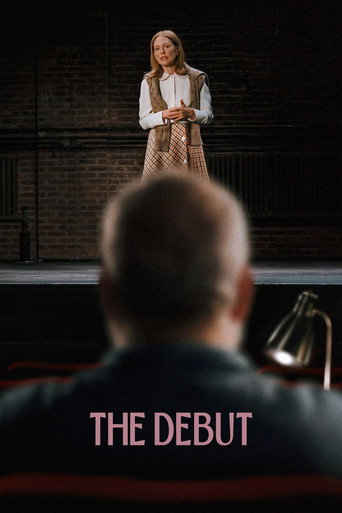
Jesse Eisenberg returns to New Jersey and the community theater world of his childhood with The Debut, a musical comedy about a shy housewife who discovers a different, and far more exciting, version of herself after stepping onto a stage for the first time. Julianne Moore plays Mona Friedman, a reserved suburban housewife who auditions for a local production of the fictional musical Nosy Neighbors and unexpectedly lands the supporting role of Miss Danielle. Under the influence of Jerry (Paul Giamatti), the production’s strong-willed director, Mona throws herself deeper into the role, allowing rehearsals and her growing commitment to the character to gradually take over her life.
BACKGROUND
The Debut is Jesse Eisenberg’s third film as a writer-director, following the forgettable When You Finish Saving the World and the Oscar-nominated A Real Pain. The idea began taking shape during the long awards run for the latter, when Eisenberg found himself wanting to follow such a personal drama with a full-blown comedy. He once again draws heavily from his personal life, only this time going back to his childhood and the beginning of his love for acting. Before he became known for his uniquely neurotic persona, Eisenberg started performing in musicals at a small community theater in New Jersey, an experience that helped him deal with his own insecurities. He wrote The Debut with that world in mind, even composing the songs for the fictional musical Nosy Neighbors himself. Once a theater kid, always a theater kid.
THE REVIEW
The film is far wackier than its trailer suggests, going beyond the conventional feel-good dramedy about a repressed housewife finding herself to explore the point where newfound freedom and purpose start to become an obsession. It also brings Eisenberg back to something he explored in A Real Pain, where David was both frustrated and fascinated by Benji’s ability to move through the world without constantly worrying about how he was supposed to behave. Mona starts much closer to David, but acting gives her permission to stop policing herself and eventually take that freedom much further than expected. A late rant from Jerry even recalls David’s frustration with people who feel entitled to ignore the script, while secretly envying them for it. Eisenberg mostly has fun with these ideas rather than digging too deeply into them, seemingly trying his own version of that freedom as a filmmaker. Something he does not always achieve.
The closest the film gets to that looseness is through Moore’s Mona. Jerry initially pushes her to really live the character, and she soon takes his advice much further than expected. She starts dressing like Miss Danielle, changes her hair, and questions every logical gap in the play (it is easy to imagine a young Eisenberg doing the same). The deeper she gets into it, the more ridiculous things become, leading to some genuinely unpredictable turns where you are never quite sure how far Mona, or the movie, is willing to go. Eisenberg has a lot of fun taking the character to unexpected places, with much of the comedy centered on Mona’s efforts to fit in with the much younger cast. Yet it is Moore that makes it all come to life.
The actress has always been courageous, but she never quite reached this level of insanity since her late-1990s work with the Coen brothers and Paul Thomas Anderson. She finally returns to that mode, unafraid to make herself seem silly with awkward movements delivered with utter precision. Her best scene, and the movie’s, comes early, when Jerry first has Mona experience the power of acting through an improvisation exercise that somehow ends with her threatening to eat poisonous rats. Moore delivers it with such manic conviction that it makes you want to try the exercise yourself.
Giamatti’s Jerry makes for a great companion. He is very funny as the bad-tempered director who treats community theater with life-or-death seriousness (his introduction is so funny!), but Giamatti once again finds the lovable heart beneath all that bitterness. In the end, Jerry wants to revive even a fraction of what Mona is experiencing for the first time.
For all its charm and laughs, the film is not as emotional as it could have been, especially in the theater scenes involving the rest of the cast. Recently, films like Theater Camp, Ghostlight, and Sing Sing had its most touching moments capturing how theater becomes a refuge for these people through delicate observation of people coming together and finally finding themselves by being someone else. Eisenberg’s numbers are all charming and clever, but feel fabricated to the point that characters in the cast need to say it out loud how important that is for them, more than once. Mona’s life outside the theater has the opposite problem, feeling so heightened and artificial that there is little there to ground what she is leaving behind or give her transformation any real emotional stakes.
FINAL THOUGHTS
The Debut can be hilarious, unpredictable, and occasionally contagious in its theater kid enthusiasm, especially when it trusts Moore and Giamatti’s terrific performances. Yet Eisenberg’s writing and direction remain too self-aware, intellectualizing emotions that should come naturally and keeping the film at a distance from the transformative power of theater it wants to celebrate. For a movie about the freedom that theater can bring, it all feels a little too rehearsed.
- 1Hadestown: The Musical
- 2Tuner
- 3The Weight
- 4Wicker
- 5Minotaur
- 81The Debut#81 of 179
- 1Minotaur
- 2The Man I Love
- 3Club Kid
- 4The Unknown
- 5La Gradiva
- 12The Debut#12 of 27
- Where to watch
- Coming soonDec 18, 2026
- Where to watch
- Coming soonFeb 18, 2027
 Play trailer


- Original title
- The Debut
- Director
- Jesse Eisenberg
- Cast
- Julianne Moore, Paul Giamatti, Halle Bailey, Jesse Eisenberg, K. Todd Freeman, Eldar Isgandarov, Susan Blommaert, Colton Ryan
- Rated
- R
- Screenwriter
- Jesse Eisenberg
- Composer
- Emile Mosseri
- Cinematography
- Drew Daniels
- Editor
- Robert Nassau
- Country

- Language
- English