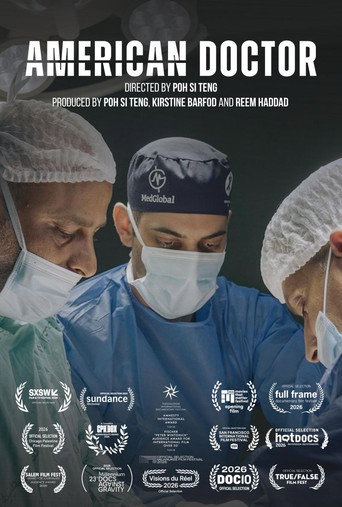
OVERVIEW
Poh Si Teng, a former New York Times video journalist making her feature debut, follows three American doctors from completely different backgrounds as they travel to Gaza during the war that followed the October 7, 2023 attacks. Rather than attempting to document the conflict as a whole, American Doctor stays with these three men: their struggle to enter Gaza, their work at Nasser Hospital in Khan Younis, what they witness there, and the responsibility they feel once they return home. By keeping its focus so personal, Teng finds a way into an enormous and politically charged subject through the experiences of people trying to save lives in the middle of it.

THE REVIEW
Teng establishes the devastation immediately, sitting with Dr. Mark Perlmutter, a Jewish orthopedic surgeon from North Carolina and one of the three doctors at the center of the film, as they look through photographs of children killed in a missile strike. When she offers to blur the images to protect their dignity, he refuses. Israel already took their dignity, he tells her, and blurring what happened would amount to journalistic malpractice. It is a difficult opening, but Teng does not simply follow it with an accumulation of horrific images. Instead, she goes back to the three doctors and asks what it takes for each of them to get there in the first place.
Rather than stacking up facts to tell its audience what to think about the war, American Doctor takes us into Gaza through three men whose backgrounds might suggest very different relationships with the conflict: Perlmutter; Thaer Ahmad, a Palestinian American emergency physician from Chicago; and Feroze Sidhwa, a trauma surgeon from California whose Zoroastrian parents emigrated from Pakistan. Bringing these three perspectives together is one of Teng’s smartest choices. Whatever history, religion, or politics someone brings to this conflict, the suffering they encounter demands to be considered first on a human level.
These are experienced doctors prepared for the challenges of an operating room, yet their biggest obstacle is simply getting there. Ahmad requires far more Israeli approvals than his colleagues, and when his clearance is pulled the night before their flight, he is left waiting in Jordan while the other two continue without him. Sidhwa, meanwhile, packs scrubs and antibiotics into his own luggage because bringing necessary supplies into Gaza has become another obstacle to providing basic medical care.
What they find at Nasser Hospital makes even the simplest procedures difficult. At one point, they cannot even provide a patient in excruciating pain with a painkiller. Teng shows the injured arriving, children caught in the violence, and doctors trying to work with increasingly limited resources. Then the hospital itself comes under attack. There is something particularly horrifying about watching a place people desperately reach in the hope of staying alive become another place where their lives are in danger.
These scenes are so powerful, and the film works best when it simply trusts the raw impact of the footage. There is one moment where Teng overplays the sentimentality: a Palestinian doctor describing how his daughter died. It moved me, and it also felt placed there to move me, appealing to our sympathy rather than trusting what the film has already shown us.
FINAL THOUGHTS
This is an extraordinarily delicate subject to write about because conversations surrounding it so often become arguments about sides, numbers, history, and who is justified in doing what. What affected me about Teng’s documentary is the way it keeps returning to a much more immediate question: what justification can possibly make the death and suffering of innocent children acceptable? At what point does pursuing those deemed responsible cease to justify the destruction inflicted upon everyone around them?
Once the doctors return home, the documentary makes its most direct political argument: American taxpayers are helping fund this war, and Americans have a responsibility to question the politicians who support it. Perlmutter, Ahmad, and Sidhwa carry what they witnessed in Gaza into interviews and into the halls of Congress, and some of them receive death threats for doing so. Many of us watching are not American and cannot vote against those politicians or decide where those tax dollars go, which leaves the harder question standing after the credits. What is our responsibility simply as human beings?
Still courtesy of Game Theory Films
- 1Hadestown: The Musical
- 2Tuner
- 3Minotaur
- 4The Weight
- 5Wicker
- 31American Doctor#31 of 208
- Where to watch
- Out of Theaters
- Where to watch
- Coming soon
 Play trailer


- Original title
- American Doctor
- Director
- Poh Si Teng
- Genre
- Documentary
- Cast
- Thaer Ahmad, Mark Perlmutter, Feroze Sidhwa, Dana Bash, Hasan Piker
- Screenwriter
- Poh Si Teng
- Composer
- Suad Bushnaq
- Cinematography
- Ibrahim Al-Otla, Chris Renteria, Arthur Nazaryan, Poh Si Teng, Ramzy Haddad
- Editor
- Christopher White, Ema Ryan Yamazaki
- Country



- Language
- English
- Budget
- $875,000
- Distributor (CA)
- Game Theory Films