
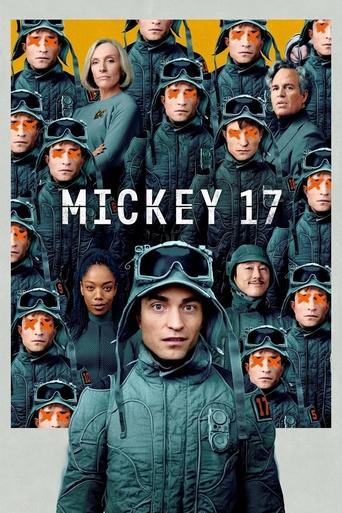
Coming off Parasite (arguably the best movie of the last 10 years, if not more), expectations for Bong Joon Ho’s Mickey 17 were understandably high, despite the constant release date changes (at one point, it was even scheduled for January, the month of “expendable” movies) and a lackluster trailer. Predictably, Mickey 17 is closer to the director’ Okja than Parasite, way too close, actually, pushing that film’s absurdity even further and recycling some of its themes.
That Mickey 17 leans in this direction isn’t entirely surprising. Now on his eighth movie, Bong Joon Ho’s career has taken two distinct paths: the gritty, genre-blending Korean filmmaker (Memories of Murder, The Host, Mother, Parasite) and the large-budget, English-language sci-fi director (Snowpiercer, Okja). He always seemed to have more fun in this category, even if his best work lies in the first. Until now, though, he had managed to balance sci-fi spectacle with his signature dark humor, sharp social commentary, and unpredictable tonal shifts. But with Mickey 17, that balance starts to crack.
Like those previous films, Mickey 17 thrives in world-building. The production design is exceptional, and Bong efficiently establishes its dystopian future without excessive exposition, quickly cluing us into a world where cloning technology exists, but is only used outside of Earth. Robert Pattinson’s Mickey becomes our surrogate for understanding these mechanics, particularly the reality of being an “expendable”. This makes for a first half that plays like a playful version of Moon (2008), except, in Moon, the protagonist didn’t realize he was being endlessly copied.
Bong, as always, excels in the small details, the slight shifts in personality between clones, the humor in Mickey’s casual acceptance of his role, and the fun elements of repeatedly dying and respawning. Some of the deaths are amusing, but nothing particularly inventive happens (Edge of Tomorrow, Source Code, Happy Death Day, Boss Level all did this before, and to be honest, better). While entertaining, it doesn’t offer anything truly fresh.
The film’s biggest strength is Robert Pattinson. He continues to surprise, delivering one of his most enjoyable performances. He brings an amusing, slightly dumb but never grating energy to Mickey, making him fun to watch while avoiding caricature. His voice work, in particular, adds a lot to the character’s charm.
But where Bong disappoints is in not fully exploring the deeper themes the premise sets up. The idea of a disposable human workforce is there, but it never evolves into something substantial. Sure, Mickey is treated as trash, given reduced rations, and disregarded, but by design, he is a passive character, and the film never engages with how he feels about his disposability. It works as comedy in the first half, but by the second, it feels hollow. By the end, Mickey hasn’t changed, and the film never pushes its existential themes further.
Instead, the movie shifts into something more akin to Okja, focusing on the exploitation of animals (represented by the alien creatures). Bong even repeats some of that film’s beats, including a gruesome scene involving a youngling’s death. But while Okja used its disturbing moments to make a statement, Mickey 17 presents this moment as cruel and unnecessary, adding nothing meaningful to the film’s main themes or stakes.
The villains don’t help. Mark Ruffalo, doing what feels like an SNL Trump impression, and Toni Collette, stuck with an unfunny running joke about sauces, are too absurd to be threatening. Snowpiercer and Okja also had exaggerated villains, but they were balanced with real menace. Here, there’s nothing grounding them, making them cartoons without real stakes.
Narratively, the film feels frustratingly unpolished, with unnecessary scenes that drag the pacing, a random fixation on the smell of a red-haired woman that goes nowhere, dispensable dream sequences, and side characters that add texture but take up significant runtime.
As it meanders toward the finish, Mickey 17 isn’t as fun as it wants to be and nowhere near as deep as you’d expect from the director of Parasite. Still, Bong’s care and cleverness make it not an expendable, but don’t expect it to match the brilliance of his best work.
Still courtesy of Warner Bros. Canada
- 1Sentimental Value
- 2Hamnet
- 3One Battle After Another
- 4Ne Zha 2
- 5Blue Moon
- 122Mickey 17#122 of 256
- Where to watch
 Netflix
 Crave
Crave- Where to watch
- Netflix
 Max
Max
 Play trailer


- Original title
- Mickey 17
- Director
- Bong Joon Ho
- Genre
- Science Fiction, Comedy, Adventure
- Cast
- Robert Pattinson, Naomi Ackie, Steven Yeun, Mark Ruffalo, Toni Collette, Anamaria Vartolomei, Daniel Henshall, Patsy Ferran
- Rated
- 14A
- Screenwriter
- Bong Joon Ho, Alex Clark, Yigit Isik
- Composer
- Jung Jae-il
- Cinematography
- Darius Khondji
- Editor
- Yang Jin-mo
- Country


- Language
- English
- Budget
- $118 million
- Box office
- $133.542 million
- Distributor (CA)
- Warner Bros. Canada