
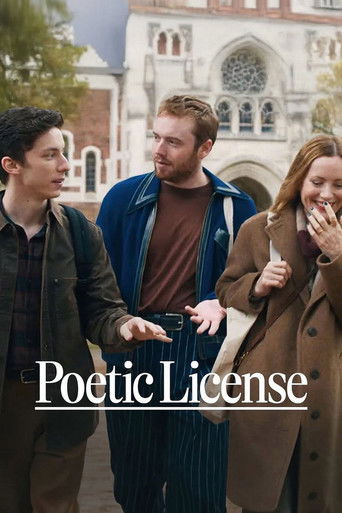
Perhaps the most pleasant surprise of the 2025 TIFF, Poetic License marks Maude Apatow’s debut behind the camera (she is the daughter of Judd Apatow, director of some of the 2000s’ most endearing comedies like The 40-Year-Old Virgin and Knocked Up) and promises an exciting new voice in comedy, a genre that desperately needs one right now.
The story follows Liz (Leslie Mann), a former therapist adjusting to a new town as her husband takes a faculty job. Feeling increasingly disconnected from her marriage and her daughter, Liz begins auditing a poetry class at the college where her husband teaches. There she stumbles into the attention of two inseparable college friends who start competing for her affection.
Using this premise to tap into her father’s trademarks of awkward social interactions, emotional contrasts, and group dynamics, Maude brings them into a new generation with far more success than her father has managed in recent years (if you haven’t seen The Bubble, be grateful and keep it that way). She shows a surprisingly assured hand in the direction, keeping the improvisational feel that fuels awkward moments and conversations that run just a little too long, while always letting humor grow from clashing personalities and generational divides. Most importantly, she carries over Judd’s best trait: putting characters first, building a story rooted in sincerity and heart.
The clearest example is Liz herself, whom the film treats with immense empathy. Few films capture adult loneliness and frustration so well, let alone comedies. Mann, who is also Maude’s real life mother, delivers a magnificent performance, exploring Liz’s intentions and longings with subtlety, letting so much come through between jokes and glances. She makes it believable that Liz would be drawn toward the energy of these young men while she struggles to have honest conversations in her marriage and feels her daughter slowly pulling away. In a just world, Mann would be considered for Oscar nominations, though the genre bias makes that unlikely.
The younger cast holds their own as well. Cooper Hoffman shows great range moving from his heavier work in The Long Walk to a looser, comedic role, while his and Andrew Barth Feldman’s antics generate plenty of laughs. Some of the funniest moments come from Ari’s wealthy lifestyle, including the detail of preparing Sam’s room with a swan-shaped towel. In typical Apatow fashion, there are also small characters that are one-scene wonders, such as the professor that keeps telling the class about her divorce.
Although it is for the most time making us laugh, there are stretches that suffer from a touch of familiar Apatow indulgence, with about ten minutes of fat that, if trimmed, could have made the film tighter and more dynamic.
But even when the pacing threatens to sag, the film rebounds with authentic emotional scenes that land with sincerity and empathy, keeping us fully invested in the characters. By the end, it feels like we’ve truly come to know them, watching each evolve in satisfying ways. That the film manages this while also being so consistently funny is just the cherry on top.
This is part of Reviews On Reels TIFF 2025 Coverage. Due to the hectic rhythm of a film festival, it may be tweaked in the future. Still courtesy of TIFF.
- 1Sentimental Value
- 2Hamnet
- 3One Battle After Another
- 4Ne Zha 2
- 5Blue Moon
- 22Poetic License#22 of 256
- 1Sentimental Value
- 2Hamnet
- 3Blue Moon
- 4Sirāt
- 5Tuner
- 8Poetic License#8 of 74
- Where to watch
- Not available for streaming
- Where to watch
- Not available for streaming
 Play trailer


- Original title
- Poetic License
- Director
- Maude Apatow
- Genre
- Comedy
- Cast
- Leslie Mann, Andrew Barth Feldman, Cooper Hoffman, Nico Parker, Method Man, Martha Kelly, Will Price, Jake Bongiovi
- Rated
- R
- Screenwriter
- Raffi Donatich
- Composer
- Jeff Morrow
- Cinematography
- Jeffrey Waldron
- Editor
- Jay Cassidy
- Country

- Language
- English
- Budget
- $18 million
- Box office
- $28.918 million