
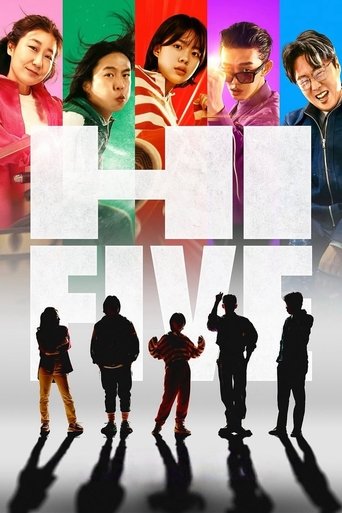
In a year where the biggest superhero tentpoles (Fantastic Four: First Steps and Superman) went out of their way to sell a return to joy and fun as an antidote to genre fatigue, the balance was much better achieved in a Korean film that cost just 5% of their budgets. Hi-Five may have far weaker effects and some familiar plot beats, but it feels fresher, funnier, and more exciting than anything its bigger-budget peers have been offering lately.
Not based on any existing comic book but instead an original story written and directed by Kang Hyeong-cheol, its premise coincidentally mirrors elements of the Fantastic Four comics while taking us back to when the focus was on ordinary people suddenly overwhelmed by newfound powers. Six characters gain superpowers after organ transplants from a mysterious donor, each tied to the organ they received. A girl receives the heart and gains super strength and speed. Another takes the lung and can blast wind projectiles. The liver heals other people’s wounds, and the pancreas falls to a religious cult leader who acquires the power to drain life energy from others, naturally becoming the antagonist. From there, the film moves through familiar beats of the genre such as discovering abilities, comedic training montages, forming the group, and the climactic showdown. None of these elements are individually original, yet the film delivers them in a consistently engaging package.
Engagement has always been the hallmark of Kang Hyeong-cheol’s filmography. Despite their different tones and purposes, his works reveal a clear instinct for crowd-pleasing entertainment, often built on ensemble dynamics. That skill is put to strong use in Hi-Five. The characters may not be individually remarkable, but they play exceptionally well off one another. Beyond the banter, mocking, and occasional conflicts lies an underlying connection as outsiders, people who are lonely and adrift. For them, the powers are less important than finally sharing something in common and building a community. The film convinces us of this feeling not only through the backstory it chooses to show, such as the protagonist’s relationship with her overprotective widowed father, but also through smaller moments, subtle looks of empathy and understanding as characters share their hardships. The characters are flawed and vulnerable, and the sense of a family being born feels genuine. It is the kind of dynamic First Steps could have desperately used.
The film makes creative use of its powers, has effective jokes, stages action scenes that are exciting despite rough effects and uneven green screen, and moves at a precise pace, juggling multiple characters in a relatively short runtime while still giving the two central arcs enough space to breathe. By the end, these characters feel changed, and that growth makes the fight scenes more emotionally resonant than they are viscerally thrilling. The true focus remains firmly on the people, even with plenty of spectacle surrounding them.
In the end, Hi-Five proves that a superhero movie does not need a $200 million price tag to entertain. It brings the genre back to basics, offering a strong ensemble, a steady stream of effective jokes, and a genuine affection for its characters. The fatigue often associated with super-hero films, yet curiously absent in popular genres like horror and rom-coms, has less to do with sheer numbers and more to do with how little these films genuinely wants to tell real stories with characters who learn and evolve. By never losing sight of the humanity at its center, Hi-Five sweeps away any sense of fatigue with ease.
- 1Sentimental Value
- 2Hamnet
- 3One Battle After Another
- 4Ne Zha 2
- 5Blue Moon
- 98Hi-Five#98 of 256
- Where to watch
 Prime Video
- Where to watch
- Not available for streaming
 Play trailer


- Original title
- 하이파이브
- Director
- Kang Hyoung-chul
- Cast
- Lee Jae-in, Ahn Jae-hong, Yoo Ah-in, Ra Mi-ran, Kim Hie-won, Oh Jung-se, Shin Gu, Jinyoung
- Screenwriter
- Kang Hyoung-chul, Yoo Sung-kwon
- Composer
- Kim Jun-seok
- Cinematography
- Choi Chan-min
- Editor
- Nam Na-young
- Country

- Language
- Korean
- Budget
- $14.45 million
- Box office
- $14.126 million