
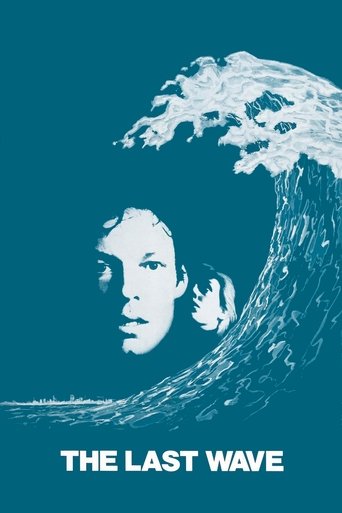

Like Picnic at Hanging Rock, Australian director Peter Weir’s previous film, The Last Wave left me with a sour taste despite having many elements I admire. Once again, the direction and cinematography are so striking that it’s frustrating to walk away feeling like the film doesn’t fully come together. Where Picnic tested my patience with its vagueness—leaving everything about the girls’ disappearance intentionally unresolved—The Last Wave is more accessible. It has a clearer narrative and a stronger sense of forward motion. But by the time it ends, I couldn’t help but think, “Was that it?”
Things start off incredibly well. Weir wastes no time plunging us into his ominous version of Australia—one plagued by sudden downpours after long droughts, chaotic traffic, and an eerie, unnatural atmosphere that feels like the beginning of something apocalyptic. We’re introduced to David Burton (Richard Chamberlain), a Sydney tax lawyer unexpectedly assigned to defend five Aboriginal men accused of killing one of their own. Burton used to have intense nightmares as a child, and soon after taking the case, those visions return—each one increasingly tied to Aboriginal beliefs and rituals.
Even with a very limited budget, Weir does a remarkable job building this creeping sense of doom. The atmosphere is heavy, the visuals are arresting, and the tension grows steadily as the line between Burton’s dreams and reality begins to blur. David himself is a strong protagonist—his gradual unraveling feels believable, and his wife thankfully isn’t written as the tired “you’re crazy” trope we see in so many similar stories. As he digs deeper and begins to suspect that the murder is connected to a much larger, even cosmic disaster, the film starts to feel big and urgent. There’s a slow-burning anxiety that suggests what’s coming could affect not just Australia, but the entire world.
But for all the unease the film captures, the ideas behind it feel frustratingly shallow. The theme of a cultural clash—between Western rationalism and Aboriginal spirituality—is introduced, but never meaningfully explored. We never really get a sense of what the Aboriginal characters think or feel (other than that they’re frightened of opening up). While the film briefly acknowledges how they’re dismissed as “city natives,” it doesn’t explore how they see themselves—or the spiritual weight of what’s unfolding through their eyes. As the story narrows in on David’s visions and personal unraveling, it completely drops the broader tension between white Australians and Aboriginal communities. And in a film that seems to build toward that very conflict, the absence of their point of view becomes hard to ignore.
In the end, The Last Wave feels like a film with a powerful premise that didn’t quite know where to go with it. The final 30 minutes, despite ending on a visually memorable note, slowly lose steam. It’s not as frustrating as Picnic at Hanging Rock—which arguably reaches higher artistic peaks but felt even more elusive—but it still left me unsatisfied. There’s a plot here, and characters that hold your attention, but the ideas they gesture toward never fully land. The mood is exceptional—but the meaning feels just out of reach.
- 1Sorcerer
- 2Annie Hall
- 3The Ascent
- 4Star Wars
- 5Close Encounters of the Third Kind
- 24The Last Wave#24 of 40
- Where to watch
 Criterion Channel
- Where to watch
- Not available for streaming
 Play trailer


- Original title
- The Last Wave
- Director
- Peter Weir
- Cast
- Richard Chamberlain, Olivia Hamnett, David Gulpilil, Frederick Parslow, Vivean Gray, Athol Compton, Peter Carroll, Walter Amagula
- Rated
- PG
- Screenwriter
- Peter Weir, Petru Popescu, Tony Morphett
- Cinematography
- Russell Boyd
- Editor
- Max Lemon
- Country

- Language
- English
- Budget
- 825000
- Box office
- $2.124 million