
Cars 2 may have been the first clear sign that Pixar’s golden streak was not, in fact, unbreakable—though I remain among its few defenders. The sequels that followed in the late 2010s—Finding Dory, Cars 3, The Incredibles 2, Toy Story 4—did little to restore that early magic. They were polished and competent, sometimes entertaining, but it became hard to ignore how comfortably Pixar was settling into the past.
To me, though, the most damaging shift came later. Call it the “safe Pixar” era: Onward, Luca, Elemental, and—depending on how generous you’re feeling—Turning Red. These were original stories that were at times earnest, occasionally delightful, yet deeply formulaic and clearly aimed at younger audiences. The studio that once thrilled children and moved their parents to tears now seemed content producing polite, mid-tier fare that asked very little of its audience—and, with that, a sort of public indifference began to form whenever a new Pixar movie was announced.
So when Elio, Pixar’s 29th feature, arrived with minimal promotion and reports of a troubled production behind it, expectations were naturally low. Its release came on the heels of Inside Out 2, a much-needed return to form, but Elio looked like another modest entry that wouldn’t ever compare with Pixar’s best.
And yet, Elio turns out to be a welcome surprise. It may not rise to the heights of Ratatouille, WALL·E, or Up, but it’s the most emotionally grounded and consistently charming of Pixar’s recent originals. It’s gentle. It has heart. It has warmth. With a likable protagonist, consistently funny humor, and a satisfying conclusion, it manages to overcome the déjà vu feeling and carve out something genuinely heartfelt.
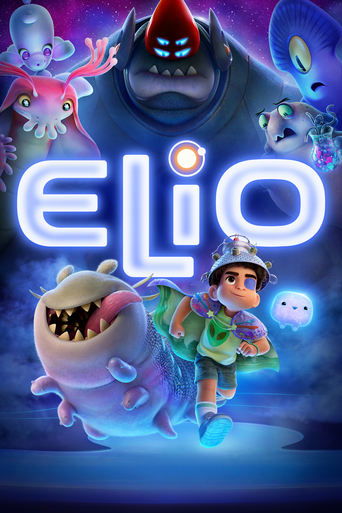
The film centers on Elio, an 11-year-old boy living with his aunt Olga after the loss of his parents. Withdrawn and imaginative, Elio is a child adrift—isolated from other kids, comforted only by his sketchbook and fantasies of distant galaxies. One of those fantasies turns unexpectedly real when, through one of Olga’s government experiments, Elio accidentally makes contact with an alien race. He’s then beamed into the Communiverse—a galactic council resembling a cosmic United Nations—where he is mistakenly introduced as Earth’s official representative.
What follows is part political misunderstanding, part coming-of-age journey, and part friendship story between Elio and a worm-like creature named Glordon, who seems just as lonely and misplaced as he is. It’s kind of the anti–Lilo & Stitch.
Like many Pixar heroes, Elio’s journey is ultimately internal—about understanding himself and his place in the world. The film deserves credit for portraying his depression in subtle, believable ways. There are no dramatic speeches or breakdowns—just a boy who’s detached and uncertain, dealing with loss in quiet ways. You can practically imagine the Inside Out emotion characters working behind the scenes in his head, following an arc similar to Riley’s.
Adding to the film’s heart is Rob Simonsen’s lovely score, which recalls the emotional sincerity of James Horner’s animated work. And Elio himself is easy to root for—sensitive, expressive, a little messy. His growing connection with Olga gives the story emotional weight, and it’s well mirrored in Glordon’s own arc with his father, both of which pay off in a very tender resolution.
Like other Pixar films that had a rocky production (Brave comes to mind), Elio isn’t without structural problems. The first act takes a bit too long to kick off, and the second act juggles too many ideas at once. The Communiverse concept isn’t particularly original, and some of the alien designs feel repetitive—reminding a lot of Ant-Man: Quantumania, while the Communiverse quarters are reminiscent of Star Wars: Revenge of the Sith. Visually, the movie’s colorful and strange, but its world-building doesn’t feel fully explored. There’s also a noticeable lack of memorable set pieces or standout action scenes.
That said, it avoids the common Pixar third-act twist, and its handling of the antagonist is one of the film’s smartest—and most touching—choices.
There are moments of that old Pixar spark—a moving tear shed in the planetarium, the way Glordon cries, the simple power of its final emotional beats. No, it’s not a film that will live in your mind the way Up or Coco might. But it is one that leaves you with a warm feeling.
Still courtesy of Walt Disney Studios Motion Pictures Canada
- 1Sentimental Value
- 2Hamnet
- 3One Battle After Another
- 4Ne Zha 2
- 5Blue Moon
- 37Elio#37 of 256
- Where to watch
 Disney+
- Where to watch
- Disney+
 Play trailer


- Original title
- Elio
- Director
- Madeline Sharafian, Domee Shi, Adrian Molina
- Genre
- Animation, Adventure, Science Fiction, Family, Comedy
- Cast
- Yonas Kibreab, Remy Edgerly, Zoe Saldaña, Brad Garrett, Brandon Moon, Jameela Jamil, Young Dylan, Jake T. Getman
- Rated
- G
- Screenwriter
- James S. Baker, Brian Larsen, Julia Cho, Mark Hammer, Mike Jones, Adrian Molina, Madeline Sharafian, Domee Shi, Tony Rosenast, Rejean Bourdages, Brandon Moon, Mitra Shahidi, Michael Wu, Steph Waldo, Yon Hui Lee, Adam Campbell, Bill Presing, Dan Park, Dean Kelly, Zilai Feng, Esteban Bravo, Jeff Call, Michael Daley, Paula Assadourian, Hyein Park, Derek Thompson, Alexander Pimwong, Rosana Sullivan, Le Tang, Margaret Spencer, Anna Benedict
- Composer
- Rob Simonsen
- Cinematography
- Matt Aspbury, Danielle Feinberg
- Editor
- Anna Wolitzky, Steve Bloom
- Country

- Language
- English
- Budget
- $150 million
- Box office
- $154.291 million
- Distributor (CA)
- Walt Disney Studios Motion Pictures Canada