

FESTIVAL REVIEW
Borrowing prestige from a well-regarded play is hardly a new trick. What screams “Oscar!” more loudly for a performer than taking on a role written to command a stage, one that has already earned its accolades and is known for sending audiences home thinking, above all else, “what a performance”? That temptation was already strong enough in 1975 for stiffly cinematic adaptations such as Hedda (1975)and The Man in the Glass Booth to find their way into existence largely on the will of actors looking for their next Oscar vehicle; it is hardly surprising to see the same instinct still alive more than 50 years later. Especially when the conversation centers on another Oscar-bait subject capable of generating plenty of popular Instagram Reels.
Originally a one-woman play that premiered in Sydney before finding much greater success when Jodie Comer was cast in its 2022 London production, Prima Facie was written by former lawyer Suzie Miller, drawing from conclusions she reached after 15 years working in criminal defense and human rights law. The play, which was filmed and presented live, earned the actress many accolades, including both an Olivier and a Tony, for her dynamic and commanding performance as a defense barrister who comes to question the law after years of defending men accused of sexual assault when she herself becomes a victim.
After later reworking the play into a novel, Miller now adapts her original work for the screen, stripping away previous adaptations’ subjectivity and rearranging the format into a more conventional presentation, with supporting characters and settings, instead of one player portraying all the roles while directly addressing the audience. Susanna White was brought in to helm that transition, and her approach includes flashbacks, voiceover, and sound effects to capture Tessa’s interiority, while trusting its lead actress, Cynthia Erivo, to carry it.
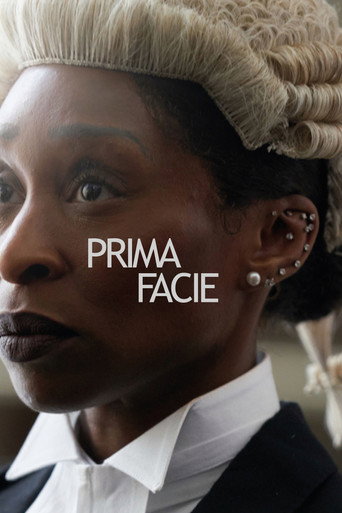
Erivo, also an executive producer, joined the project before Wicked reached cinema and is no stranger to carrying projects that rely on the strength of a single performer. Just a few months later, she starred in a one-woman production of Dracula, where she was tasked with playing 23 different characters. Her presence also adds an interesting layer to the story, making her character an outsider both in gender and in race. The film proudly embraces that identity, with the actress’s distinctive nails and tattoos, a heavily pierced ear, and a habit of walking into the office listening to music through her AirPods, only to, not know how to make her feel like a real person. Suddenly, we are not watching a human being with past experiences and believable sentiments, but a character being acted out, reciting lines clearly written to address the audience directly on a stage.
To White and Miller’s credit, the first half works quite well, organically changing scenery and turning Tessa’s thoughts into natural dialogue as it introduces the people around her. We meet her mother and brother, her co-workers, and Julian, who we know is trouble from the minute we see him. They start dating while we get to see Tessa happy, until a boundary is crossed. Signs of theatricality are already present, like their distractingly robotic first sexual encounter, but White finally overcompensates during the rape itself, alternating the assault with visions of breaking glass, topped by a loud, ominous score from Isobel Waller-Bridge. From that moment on, almost nothing connects with the same ease.
Erivo tries her best to capture what the event does to Tessa, but does not always succeed. Her performance is, in a way, the opposite of her arcs in The Color Purple (Broadway) and Wicked, conveying a character losing all her convictions and growing increasingly insecure, and she knows how to capture the look of a broken person. Yet this time, it never feels like she pushes it far enough, and her body language sometimes contradicts what her character is saying. It doesn’t help that the script constantly has her spell out those feelings. Equally distracting is the film’s increasingly vague sense of time and space. Many scenes occur mostly between two characters, with secondary characters disappearing for long stretches and the film needing to catch us up every time we see them again.
That theatricality culminates in the courtroom, where Erivo directs herself toward the jury as if addressing the audience. “I’ve got things to say,” she announces, before proceeding to preach the moral of the story. We haven’t truly felt her transformation or frustration develop, so when she says she has lost faith in the system, the feeling seems to come out of nowhere. Erivo ends up with some of the best moments of her career, but also some of her worst, with a few scenes making it obvious that, instead of acting for the last row, she is performing for the Oscar voters’ minds.
FINAL THOUGHTS
Prima Facie has important things to say, but its message comes across as preachy and uncinematic. In the translation from a one-woman play into a conventional feature film, it loses the creativity and uniqueness of its source. It doesn’t feel overly stagey but awkward nonetheless. What remains is the important subject and an inconsistent and distractingly self-aware performance from Erivo.
- 1Hadestown: The Musical
- 2Tuner
- 3The Weight
- 4Wicker
- 5Minotaur
- 152Prima Facie#152 of 184
- 1Minotaur
- 2The Man I Love
- 3Club Kid
- 4The Unknown
- 5La Gradiva
- 28Prima Facie#28 of 33
- Where to watch
- Coming soon
- Where to watch
- Coming soon


- Original title
- Prima Facie
- Director
- Susanna White
- Genre
- Drama
- Cast
- Cynthia Erivo, Daniel Ings, Elizabeth Dulau, Noma Dumezweni, Toheeb Jimoh, Harry Treadaway, Sarah Junillon, Elliot Levey
- Screenwriter
- Suzie Miller
- Cinematography
- Mike Eley, Núria Pérez
- Editor
- Justine Wright
- Country


- Language
- English