
OVERVIEW
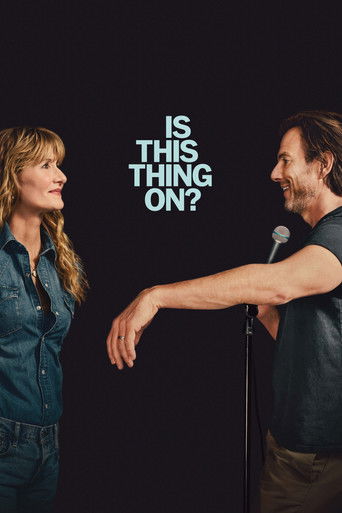
Is This Thing On? follows Alex (Will Arnett) and Tess (Laura Dern) as they navigate separation and handle divorce arrangements while raising their children in New York City. Alex attempts to cope by starting a stand-up comedy routine, while Tess returns to coaching a young volleyball team. The film remains focused and intimate, using humor to examine the ongoing negotiations between ex-partners and the challenge of maintaining a functional family across two homes.
BACKGROUND
Inspired loosely by British comedian John Bishop’s life, the script originated from stories he shared with Will Arnett about how stand-up comedy helped him navigate a divorce. Arnett, a Canadian actor, co-wrote the screenplay with Mark Chappell and presented it to Bradley Cooper while he was filming Maestro. For Cooper, who has mostly directed projects aimed at award recognition, this script presented an opportunity to create a smaller, more personal film. It also provided a motivation to finally collaborate with Arnett, a friend who previously helped him achieve sobriety.
THE REVIEW
If A Star Is Born, and Maestro proved Bradley Cooper can handle prestige craft and showcase performances, the question of whether he is efficient in crafting a lived-in story had not yet been answered, nor what he really wants to say as a director. Would the actor-turned-director be able to build and end a conversation at the right moment without relying on spectacle or montage? How would he tackle more naturalistic performances? With no Lady Gaga dominating the screen and without the craft to distract, Is This Thing On? becomes that test.
And the result is average. He succeeds once again with his cast, giving them room to shine, which becomes a great showcase for the leading duo. It is nice seeing Dern play a more natural, low-key character (the last time I saw her this natural was in Kelly Reichardt’s Certain Women). She nails Tess’s confusion and delivers some heartbreaking moments, giving weight appropriate due to the years of accumulated remorse. When she feels excited to go on a date, it does feel like a huge weight has been lifted from her shoulders.
Arnett, meanwhile, is unsurprisingly great at mixing humor with his character’s depression (as he has proven in his voice work on BoJack Horseman). He is at his best during the stand-up routine where he is quite funny, while also going through many emotions at once (I could have sworn that he came from a comedian background, but nope, this is his first experience). Like Dern, it’s clear by the start of the film how suffocated his character is, and by the end, we see a totally different person, ready to take the next step in his life. The film also gives us an Arnett and Amy Sedaris reunion, which is the closest to a live-action BoJack Horseman we will ever get.
While the performances succeed and keep us invested in these characters, it’s hard to know whether Cooper just trusts his actors too much or simply doesn’t have much to say with the material. On his side, he keeps the camera very close to the performers’ faces for most of the runtime, which he achieves by operating it himself. However, it often seems that he relies solely on the actors to create rhythm and energy in the scenes. Many scenes lack a clear progression, with conversations lingering beyond their point, suggesting he may not always have a precise vision of what he wants to express.
There are times when the director also treats the script as deeper than it actually is. The script is quite basic and keeps its insights surface-level, with heavy-handed dialogue that reaches simplistic conclusions. Cooper’s staging then treats those lines as carrying significant weight, holding on faces, stretching pauses, and pushing seriousness even when the writing does not earn that intensity. There are stretches where nothing happens, and the movie feels like it’s stalling for time, like a three-minute “Amazing Grace” sequence that drags on forever (secondary characters can also be very annoying, especially Copper’s). These extra scenes and characters might work as breathing room in a heavier film, but in this film, they just feel bloated, as if it truly only needed the secondary characters in the comedy club, which are far more interesting.
There are a few flourishes that work, some clever cuts in the film’s middle. Even here, Cooper still feels like he is trying to prove his directing chops, hard at work to convince us he can do it, while still keeping us at arm’s length. The film ends on a simplistic conclusion, revealing that, after all, it didn’t have much to say. Sometimes, all you need is to go do stand up to realize that you’ve been the problem all along, I guess?
FINAL THOUGHTS
Is This Thing On? lands a handful of laughs when Alex is on stage, and Arnett and Dern keep it engaging, capturing their characters’ evolution throughout the film convincingly. But Cooper often leans into the seriousness that the writing does not build toward, and the movie starts to feel over-shaped for such a small story. There are moments that feel true about divorce logistics and coping. But as a whole, it feels heavier than it needed to be. The thing is not on.
- 1Sentimental Value
- 2Hamnet
- 3One Battle After Another
- 4Ne Zha 2
- 5Blue Moon
- 147Is This Thing On?#147 of 256
- Where to watch
 Disney+
- Where to watch
- Disney+
 Play trailer


- Original title
- Is This Thing On?
- Director
- Bradley Cooper
- Cast
- Will Arnett, Laura Dern, Andra Day, Bradley Cooper, Christine Ebersole, Ciarán Hinds, Amy Sedaris, Sean Hayes
- Rated
- G
- Screenwriter
- Will Arnett, Mark Chappell, Bradley Cooper, John Bishop
- Composer
- James Newberry
- Cinematography
- Matthew Libatique
- Editor
- Charlie Greene
- Country


- Language
- English
- Budget
- $15 million
- Box office
- $10.134 million