
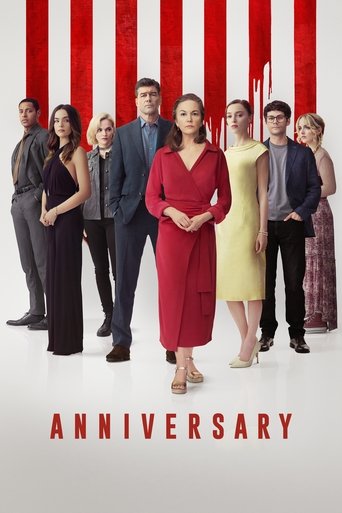
We have seen in the past decade political disagreement turn into personal distance. Modern politics now divides dinner tables, with fragile phrases like “no politics at the table” becoming routine as convictions pull tighter than kinship and every opinion risks becoming a declaration of identity. Connections are no longer built on values shared but on sides chosen, and Anniversary, Jan Komasa’s English language debut (even if Good Boy reached some audiences first), brings that reality home through a once tight family slowly torn apart by ideology. It is an ideology that, ironically, claims that division itself is the problem.
The film follows a structure reminiscent of Danny Boyle’s Steve Jobs, unfolding in contained intervals where time jumps create a timeline of decay. It is set around a series of family gatherings across five years, beginning with Ellen and Paul Taylor’s twenty fifth anniversary dinner, where their three daughters and son reunite to celebrate their parents’ union. During that evening, their son introduces his new girlfriend, Liz, a writer and the face of a rising movement called The Change. From there, title cards mark the passage of time, each holiday or anniversary revealing new emotional cracks as once ordinary disagreements harden into estrangement.
It is a promising concept that makes you wish the film had the nuance and restraint to match it. Anniversary squanders that potential by starting and ending too far apart, trying to fit years of transformation into two rushed hours. It begins well, with grounded, tense exchanges, characters carefully walking on eggshells, measuring words and reciting rehearsed lines, but as the years pass, Komasa shifts from a subtle Thanksgiving table discussion to an apocalyptic dystopian world. By the final stretch, the film feels one jump away from a Last of Us style wasteland, where humanity has all but destroyed itself. In theory, that rapid escalation might mirror our current social climate, and five years might indeed be how much time it takes, but here it feels sloppy, sacrificing believable character growth in the process. The tonal shift is so abrupt that emotional investment fades, despite the best efforts of a talented cast.
Much of the problem lies in Komasa’s direction, which treats every exchange with the heavy seriousness of an Oscar contender, even when the dialogue grows exaggerated. Where his balance of satire and sincerity worked within Good Boy’s smaller scale, it collapses here. The first act carries genuine tension, full of awkward silences and polite restraint, but by the third act that same solemnity makes the drama hard to take seriously. The visual tone and score stay somber, so any intended irony never lands.
The bigger issue, though, is the script. It oversimplifies complex ideas and tries to juggle too many subplots. The story desperately needed focus, fewer characters, and a more concentrated conflict. The fact that Liz embodies both the opposing worldview and the leadership of the movement itself feels too exaggerated, making it difficult to draw parallels with our current times or real life experiences. Anniversary also skips over the complicated middle ground, showing only the aftermath of extremism rather than how it quietly takes root. As a result, its warning about ideology tearing families apart becomes too extreme to feel human.
The cast does what it can to hold everything together. Diane Lane, Kyle Chandler, Phoebe Dynevor, Mckenna Grace, and Zoey Deutch work hard to ground their characters in genuine emotion, convincingly portraying a family whose bonds feel lived in. Komasa captures those small, truthful moments well, a sister teasing another about her assistant, a mother worrying her son is abandoning his real passion. Dylan O’Brien, however, feels miscast, his broad performance veering into cartoonish villainy that seems far more appropriate for a RoboCop reboot than the film Komasa appears to be trying to make.
Beneath it all, the core ideology remains vague and thinly sketched, even as the film insists that the beliefs themselves are secondary to their impact. Still, Anniversary holds enough ideas for two entirely different projects, a sharp domestic drama about political alienation or a full dystopian satire about control and conformity. Its attempt to merge the two backfires, and by the time we reach the climactic TV broadcast, what is meant to be tense ends up unintentionally hilarious. We are left mourning the film it could have been, one that trusted its great premise and kept it at a much smaller scale.
Still courtesy of Cineplex Pictures
- 1Sentimental Value
- 2Hamnet
- 3One Battle After Another
- 4Ne Zha 2
- 5Blue Moon
- 215Anniversary#215 of 256
- Where to watch
 Crave
Crave- Where to watch
 Prime Video
 Play trailer


- Original title
- Anniversary
- Director
- Jan Komasa
- Cast
- Diane Lane, Kyle Chandler, Madeline Brewer, Zoey Deutch, Phoebe Dynevor, Dylan O'Brien, Mckenna Grace, Daryl McCormack
- Rated
- R
- Screenwriter
- Lori Rosene-Gambino, Jan Komasa
- Composer
- Danny Bensi, Saunder Jurriaans
- Cinematography
- Piotr Sobociński Jr.
- Editor
- Michał Czarnecki
- Country


- Language
- English
- Box office
- 672711
- Distributor (CA)
- Cineplex Pictures