
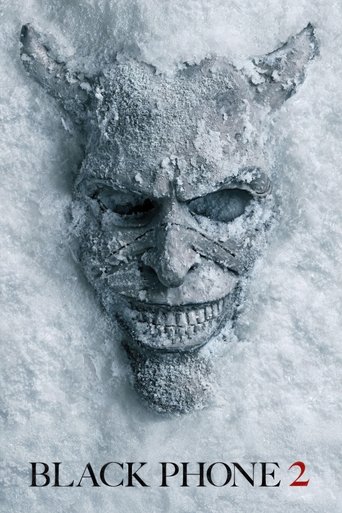
“You of all people know that dead is just a word.” That is the line uttered by The Grabber, villain of the 2022 surprise hit The Black Phone, in the promotional campaign for its sequel arriving three years later. In it, the line is addressed to the main character, but it might as well be aimed at horror fans who should know by now that a very successful original film will inevitably spawn a sequel, whether or not the first story left that door open or hung up the phone for good. After insisting that the original worked because it ended exactly where it should, director Scott Derrickson (Doctor Strange) was eventually persuaded to return when Joe Hill, Stephen King’s son and author of the original short story, pitched him a concept that supposedly would not be a cash grab (yeah, right) but would expand the universe thematically.
That idea was to explore the aftermath, and more specifically, the trauma left behind after the events of a horror story. While the first film took place almost entirely in a basement where the kidnapped Finney (Mason Thames) could communicate with the ghosts of his captor’s previous victims through a disconnected phone, this sequel finds him and his sister reaching out to the killer’s earliest victims while being haunted by the ghost of the villain himself. The scope expands from a claustrophobic basement to a cold church camp, creating a different yet still oppressive atmosphere while trying hard to feel like a natural continuation.
But Derrickson was right in those interviews. The Black Phone was a complete story that left little room to expand. By its conclusion, Finney had already honored the killer’s victims, found his strength, and closed his arc. The sequel revisits those same emotional beats but never convinces that its continuation is as compelling.
Part of the problem lies in how uncertain the film’s focus feels. Instead of exploring the lives of the first three victims or showing how Finney remains captive to The Grabber’s memory, the story shifts toward Gwen and her psychic visions. After establishing that Finney can no longer live a normal life after the first film’s events, the sequel quickly sidelines him, turning him into a reactive presence. Gwen, played with remarkable conviction by Madeleine McGraw, takes on a faith-versus-visions conflict that feels like it belongs in another movie. Her storyline has emotional potential, but it never fully connects to Finney’s trauma or to the film’s central tension.
To tie Gwen’s arc more directly to The Grabber, the script adds new revelations about the siblings’ mother and the killer, creating connections that feel forced and underdeveloped. These additions give the sense of a story straining to justify its existence rather than expanding it with purpose. Whenever the focus returns to Finney, it feels as if the film suddenly remembers him, especially during the final confrontation, which lands without the emotional payoff it seems to aim for.
And yet, when you look past these narrative stretches, Black Phone 2 is a very well executed horror film. Derrickson’s craft remains sharp. The frozen lake, the deserted campgrounds, and the empty dorms are used with precision, each location adding to the film’s eerie calm. The analog look of Gwen’s visions, shot on film and switching back to digital for reality, is once again clever and immersive. Derrickson still knows how to build dread through motion and silence: the slow pan as Finney talks to The Grabber revealing the children ghosts watching, the nighttime confrontation between the siblings and their father framed through shifting perspectives, and the startling kitchen scene where outsiders witness The Grabber as an invisible force lifting and throwing Gwen. Even the touches of humor are smartly placed, keeping the experience from becoming too heavy despite dealing with trauma and the lingering grief over brutally murdered children.
In the end, Black Phone 2’s biggest flaw is that its attempts to connect and expand on the first movie end up tangling it. Finney’s recovery from trauma, Gwen’s faith conflict, the new backstory about their mother, and the search for the missing boys never fuse into a clear emotional center. If the story had focused on new characters confronting the ghost of The Grabber, or better yet, if it had been reimagined as a standalone film set in the same chilling camp, it might have worked more cohesively. But then it would not have had that recognizable mask on the poster.
As it stands, Black Phone 2 offers effective scares, evocative visuals, and a confident director at work, but never quite convinces you that The Black Phone needed a sequel.
- 1Sentimental Value
- 2Hamnet
- 3One Battle After Another
- 4Ne Zha 2
- 5Blue Moon
- 165Black Phone 2#165 of 256
- Where to watch
 Prime Video
- Where to watch
- Prime Video
 Play trailer


- Original title
- Black Phone 2
- Director
- Scott Derrickson
- Cast
- Ethan Hawke, Mason Thames, Madeleine McGraw, Demián Bichir, Miguel Mora, Jeremy Davies, Arianna Rivas, Maev Beaty
- Rated
- R
- Screenwriter
- Scott Derrickson, C. Robert Cargill, Joe Hill, Vincent Proce
- Composer
- Atticus Derrickson
- Cinematography
- Pär M. Ekberg
- Editor
- Louise Ford
- Country

- Language
- English
- Budget
- $30 million
- Box office
- $132.676 million
- Distributor (CA)
- Universal Pictures Canada