
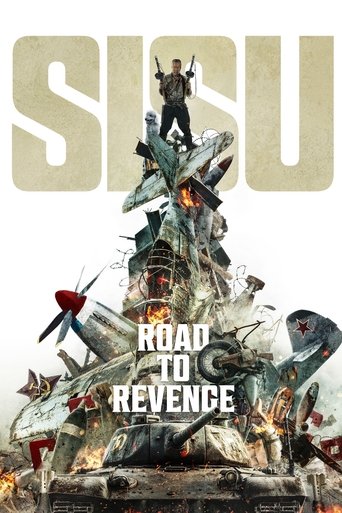
If the first Sisu was John Wick in wartime Finland, its sequel feels like Jalmari Helander’s way of showing how the last two Indiana Jones movies might have looked if he were in charge. The brutal simplicity and slow-burn tension that gave the first film its power are gone, along with the fascination of watching a man face impossible odds again and again. Instead, there are bigger explosions, crazier stunts, and a rush of pure spectacle. The script only half connects its ideas, serving mostly as an excuse for one ambitious set piece after another. Helander still channels Sergio Leone’s western grit and the pulp action and grindhouse cinema of the 1960s and 1970s, which naturally makes the film feel like Tarantino territory, even if both are drawing from the same cinematic well. The result feels like Dial of Destiny remade by Tarantino, minus the needle drops.
The plot doesn’t require knowledge of the first film to be understood. Aatami Korpi, the nearly silent Finnish commando who refuses to die, finally returns to the house where his family was murdered. The problem is that the area now belongs to the Soviet Union, whose borders expanded after the war. Aatami dismantles the old wooden house, loads its logs onto a truck, and sets out to rebuild it on peaceful Finnish soil. The Red Army, having spotted him crossing their territory, sends soldiers after him, including Igor Draganov (Stephen Lang), the commander who killed his family. From there, the film adopts a structure closer to Mad Max: Fury Road, with Aatami simply trying to reach safety while chaos follows him.
What hurts Sisu: Road to Revenge most is how little the motivations make sense. Contrary to what the title might suggest, Aatami isn’t seeking revenge, driven only by the simple wish to be left in peace. Draganov, shouting about fixing a mistake, never convinces as more than a man chasing his way out of prison and the reward that comes with it rather than a personal vendetta. The Soviets themselves have little reason to stop Aatami, yet they chase him and waste resources anyway. Because no pursuit feels personal, all characters become reactive, and the story loses its emotional stakes. In the first film, Aatami’s endurance and his decision to rescue captives gave him depth; here, he is again burdened with something to protect, much larger this time, but one that matters only to him. His obstacles feel imposed, including the vengeance that would not even cross his mind if the film did not force it upon him.
Because of that, it falls to Jorma Tommila’s fierce, weary performance to make us care. He brings a sense of exhaustion, as if he’s a man who has earned his peace, but the world won’t give him that choice. Stephen Lang also seems to relish his role, delivering the same ferocity he showed in Avatar and Don’t Breathe. Yet most characters move with the detached logic of video game NPCs, such as when Aatami inexplicably ignores Igor during their first encounter. At one point, a pilot wastes all his bullets long before his plane even reaches Aatami’s truck, firing wildly like a child at an arcade game. If the first Sisu earned its title, “determined against overwhelming odds,” through the sheer resilience of its hero, the odds here feel far less overwhelming, since the goons seem eager to do half the work for him.
Yet that hardly matters to Helander. Pulling double duty as writer and director, as he usually does, it often feels like the writer in him is simply handing the director in him excuses to stage wild set pieces, and those more than deliver. There are planes chasing trucks, battles inside and outside a moving train, and even inspired uses of the house’s logs as weapons. The choreography is sharp, the stunts impressive, and the humor well-timed. In other words, these are loving recreations of the best Indiana Jones moments from Raiders of the Lost Ark and The Last Crusade.
Those two Spielberg films remain among my personal favorites, and seeing their spirit reborn here was pure joy. A plane tilts ninety degrees to squeeze through a narrow road during a chase, a tank performs a front flip that made the entire audience cheer, and leaping from one train car to another is as fun as ever. I didn’t care much about the characters or their motivations, but I was thrilled from start to finish by the film’s cartoonish energy. Sisu: Road to Revenge might not have the grit or mythic weight of the first film, but as adventure escapism, it is undeniably entertaining. It even ends on a poignant note that feels like a perfect conclusion to the story, and I truly hope it remains that way. Go for the front-flipping tank, and treat everything else as the ride that takes you there.
- 1Sentimental Value
- 2Hamnet
- 3One Battle After Another
- 4Ne Zha 2
- 5Blue Moon
- 55Sisu: Road to Revenge#55 of 256
- Where to watch
 Crave
Crave- Where to watch
 Max
Max
 Play trailer


- Original title
- Sisu 2
- Director
- Jalmari Helander
- Cast
- Jorma Tommila, Stephen Lang, Richard Brake, Tommi Korpela, Kaspar Velberg, Pääru Oja, Erki Laur, Maksim Demidov
- Rated
- 18A
- Screenwriter
- Jalmari Helander
- Composer
- Juri Seppä, Tuomas Wäinölä
- Cinematography
- Mika Orasmaa, Gunnar Laal
- Editor
- Juho Virolainen
- Country


- Language
- Finnish
- Budget
- $12.2 million
- Box office
- $9.812 million