
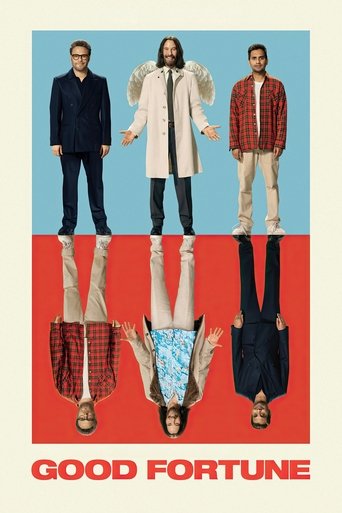
Even if trying to be about something, proposing conversations on class, empathy and morality, don’t expect Good Fortune, the new comedy by Aziz Ansari, finally delivering his first film as a director, to truly say something of note about the rich. A film with a price tag of 30 million dollars, made by and with multi-millionaire actors, is about as much of an empathy project as feeling generous because you donated your seventeen cents in spare change. Perhaps born with good intentions, it is as toothless and empty as it can be. Not that you would expect a Sean Baker film out of a comedy starring Keanu Reeves as an angel with small wings, neglected to the lowest ranking of heavenly jobs, nudging people while driving. All would be forgiven if the comedy were, you know, funny. As it stands, it provides a few chuckle-worthy scenes, but overall it is a forgettable affair, with Reeves’ awkward performance (intentional or not) being its only commendable point.
After Ansari’s first foray into directing was shelved mid-production due to a complaint of inappropriate behaviour filed against actor Bill Murray, and after Ansari himself took a break following his own sexual misconduct allegation, it’s understandable that his first completed film would be a safe, vanilla story and risk-free, featuring established and bankable names like Seth Rogen, Keanu Reeves, and Keke Palmer. Its potential as a modern retelling of The Prince and the Pauper could have led to sharper insights in the right hands, but Ansari is mostly interested in the safest possible outcome.
The film follows Arj (Ansari), a struggling documentary editor who bounces from gig to gig, as he switches places with Jeff (Rogen), a wealthy tech millionaire, through the meddling of Gabriel (Reeves), a lower-tier angel trying to prove he can redeem a soul. Things get mildly interesting when Arj, instead of rejecting Jeff’s luxurious lifestyle, actually enjoys it and refuses to return to his old life, complicating Gabriel’s plan, which was meant to prove that he could save a lost soul by helping them become a better person.
The cast does what it can with the material. Ansari brings his usual way of interrogating modern life, mixed with self-deprecating narcissism and a clear awareness of his hyperactive, mildly neurotic persona, aided by his high-pitched and nasal voice. He is likable enough as a comedic lead, though not particularly memorable. Much of the humor revolves around his frustration with bad luck, like having a paying gig cancelled after waiting in line for two hours, but the film never takes his misfortunes far enough for us to actually feel sorry for him. On the opposite side, Seth Rogen brings his familiar loud persona, balanced with more control and warmth which the actor learned how to bring over the years, balancing his loud and hoarse voice with a surprising touch of vulnerability. When Jeff realizes Arj has used his credit card, there’s a hint of genuine disappointment that makes Jeff the most human and sympathetic character of the film. Keke Palmer injects energy into her scenes, but the script never figures out how to use her or how to use her to push Arj toward change.
The most curious element is Keanu Reeves himself and the whole angel concept. The early scenes of Gabriel among other angels, pointing to his tiny wings or going about his celestial routine of saving texting drivers, are delightful (and aided by a cute score by Carter Burwell, not an adjective often associated with this composer). Reeves gives what might be his most Keanu Reeves-like performance, full of stilted delivery, odd pauses, and robotic phrasing. It is hard to tell if he is exaggerating these traits on purpose or just trying to fit the tone of the film, but it works for a while.
Once the film establishes its characters and sets up its high-concept premise, it begins to lose interest in itself. The ideas are all there: an angel forced to live among humans, a millionaire trying to survive as an ordinary man, a gig worker discovering the comfort of wealth. Yet none of these threads develop into real conflict or memorable comedy. The laughs that do appear are mild and quickly forgotten. Without momentum or genuine emotion, Good Fortune drifts toward its conclusion with no sense of payoff. Disappointing, especially considering how much potential was within reach.
Still courtesy of Cineplex Pictures
- 1Sentimental Value
- 2Hamnet
- 3One Battle After Another
- 4Ne Zha 2
- 5Blue Moon
- 224Good Fortune#224 of 256
- Where to watch
 Crave
Crave- Where to watch
 Prime Video
 Play trailer


- Original title
- Good Fortune
- Director
- Aziz Ansari
- Cast
- Keanu Reeves, Aziz Ansari, Seth Rogen, Keke Palmer, Sandra Oh, Sherry Cola, Stephen McKinley Henderson, Blanca Araceli
- Rated
- 14A
- Screenwriter
- Aziz Ansari
- Composer
- Carter Burwell
- Cinematography
- Adam Newport-Berra
- Country

- Language
- English
- Budget
- $30 million
- Box office
- $26.117 million
- Distributor (CA)
- Cineplex Pictures