
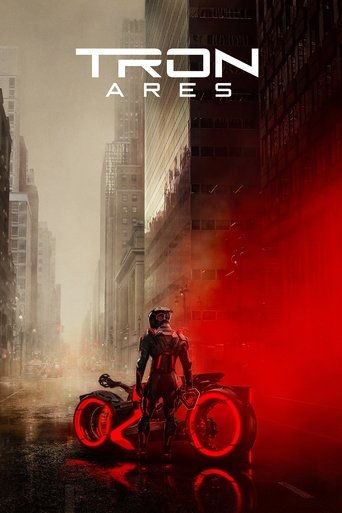
It is ironic that a franchise about people entering digital worlds filled with light and speed has yet to produce a film that could truly be called fun. Visionary, yes. Stylish, certainly. But enjoyable? Not yet. For some reason, these movies insist on taking their own concept far too seriously, and TRON: Ares continues that habit. It brings motorcycle chases into the real world, more sleek neon, and another electronic score from a famous duo, yet once again feels too brooding for its own good. The result is a film filled with half-formed ideas, joyless characters, and a narrative that manages to be both convoluted and painfully predictable, making the experience feel more like a chore than an adventure.
The writing was on the wall. The entry tries to revive a forty-three-year-old franchise, arriving fifteen years after Tron: Legacy received a mild reception and disappointing box office. Despite the poor reception at the time, that film went on to gain a following on the internet, but had its sequel canceled after Tomorrowland tanked at the box office and Disney grew worried about its success. In the late 2010s, Jared Leto became attached, and a new direction for the franchise was announced. After this announcement, however, the pandemic happened, and as the years went on, Leto’s popularity decreased heavily with poor career choices (Morbius), poor performances (Suicide Squad), and poor personal actions. With the choice to center its marketing on him and the decision to ignore the previous installment’s events, people were not exactly celebrating its return.
The film once again involves humans and digital characters being transported between the artificial world and the real one, all locked in a race to find the “Permanence Code,” a program that materializes digital constructions, something that could change the future of humanity depending on the hands in which it falls (as always).
Looking to use it “for good” is Eve Kim (Greta Lee), whose sister died of cancer, while Julian (Evan Peters) wants to weaponize it.
The film uses this clash to make a point about AI use, relevant but shallow. It never goes deeper than the obvious argument that technology itself is neutral and that its effect on society depends on how humans use it, you know, like any device in any movie ever made. Characters take turns delivering speeches about the ethics of creation and control, but none of it builds to insight or drama.
The film is directed by Joachim Rønning, who, after directing the Oscar-nominated Kon-Tiki, has become Disney’s go-to filmmaker for trying to bring new life into sequels of faded franchises (neither Pirates of the Caribbean: Dead Men Tell No Tales nor Maleficent: Mistress of Evil really sparked new life into their franchises). He captures what a Tron film should look like, and it certainly looks expensive, filled with pulsating light and glossy surfaces that would make for a great music video backdrop. The sound is just as dominant, with a booming and ultra-cool Nine Inch Nails score that certainly sounds modern (perhaps too modern for my more melodically inclined sensibilities), never coming close to achieving the brilliant merge between symphonic and electronic that Daft Punk brought to the last entry.
If you can turn off your brain and accept the film as a visual ride, there are moments where the imagery impresses. But even then, the constant cutting and quick zooms make even the best sequences disorienting and frustrating. The film, and especially the dialogue, feels truncated, and the action scenes are not cohesive. If a simple scene that has Athena (Jodie Turner-Smith) running through a parking lot toward Eve as she attempts to turn on her motorcycle fails to generate any suspense, the larger and more elaborate chase sequences never stood a chance. There are franchise callbacks that few will care about and attempts at humor that land awkwardly, while the sound design combined with the insistent score grows tiring.
But even if the scenes don’t fully embrace their opportunities, what ultimately sinks the film is how serious it all feels. The villain scenes, with his mother repeatedly telling him that he is no good, are truly unengaging, and centering the film on a stoic Jared Leto, meant to be the film’s most important character and the one who goes through the biggest arc, becomes a problem. Surprisingly, the actor delivers the best performance in the film and offers some traces of emotional complexity that contrast with how black-and-white the other characters are. Greta Lee is visibly lost in the digital sets, and her character’s backstory never quite clicks, while Evan Peters goes through the motions. Not as much as Jeff Bridges, though, who appears for an extended cameo and feels extremely uninterested.
No emotional connection is ever formed, and the stakes never become palpable. After some point, we lose interest, and it all becomes visual and auditory noise. In the end, TRON: Ares becomes a blockbuster that fails to thrill, that wants to say something about technology but never finds a compelling argument. It looks good, sounds loud, but leaves no impression. Its biggest gift to the franchise is making the previous two look better in comparison.
- 1Sentimental Value
- 2Hamnet
- 3One Battle After Another
- 4Ne Zha 2
- 5Blue Moon
- 247TRON: Ares#247 of 256
- Where to watch
 Disney+
- Where to watch
- Disney+
 Play trailer


- Original title
- TRON: Ares
- Director
- Joachim Rønning
- Genre
- Science Fiction, Adventure, Action
- Cast
- Jared Leto, Greta Lee, Evan Peters, Gillian Anderson, Jodie Turner-Smith, Jeff Bridges, Hasan Minhaj, Arturo Castro
- Rated
- PG
- Screenwriter
- Jesse Wigutow, Tracey Wilson, David DiGilio
- Composer
- Trent Reznor, Atticus Ross
- Cinematography
- Jeff Cronenweth, Hans Bjerno
- Editor
- Tyler Nelson
- Country

- Language
- English
- Budget
- $220 million
- Box office
- $142.25 million