
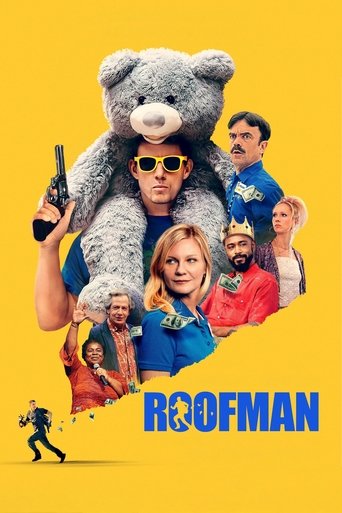
A real-life tale so strange it could have been mistaken for a movie now becomes a movie itself, one that delivers equal parts entertainment from its outrageous premise and insight into the man who lived it. On the surface it may seem like a silly comedy, but it ultimately unfolds as a character study that uncovers genuine heart and humanity in a story almost too ridiculous to believe.
The “too crazy to be true” story is that of Jeffrey Manchester, a down-on-his-luck criminal who, after being caught robbing McDonald’s by crawling through their roofs, escaped prison and spent months secretly living inside a Toys “R” Us. There, he befriended an employee who had no idea he was an outlaw. With that, the film surprisingly studies loneliness while walking the line between empathy and accountability. In practice, the film plays like a hybrid of The Terminal, Catch Me If You Can, American Animals, and Better Call Saul, with a touch of the director’s own The Place Beyond the Pines. It is also a perfect showcase for Channing Tatum’s charisma.
One of the film’s biggest achievements is how much it entertains with its main character, making him likable and “nice” while never justifying or siding with him. Tatum plays that well, as if the character knows at all times the inevitability of his errors, yet his emptiness underneath forces him to connect and form a surrogate family, which goes against his plan to escape. We might feel bad for him, but the film never asks us to root against justice. If Tatum keeps the movie buoyant with his humor and screen presence, Kirsten Dunst truly elevates it from what could have been a movie-of-the-week plot into something heartfelt and tragic, bringing effective nuances like the way her voice briefly breaks during a phone call. She makes the character strong yet visibly in pain, and watching her slowly open up to Manchester because he brings happiness to her daughter is heartbreaking. The rest of the cast (Peter Dinklage, Juno Temple, LaKeith Stanfield, and Ben Mendelsohn) clearly enjoy the material, with Mendelsohn even surprising with a strong singing voice.
For director Derek Cianfrance, the film marks a total shift in his career, even if it follows a few themes he had explored before. After two extremely heavy films and a break of more than ten years, he wanted to make something lighter, yet he never loses the humanity of his characters. He shows respect for the real story, framing it as a drama with comical situations rather than the other way around. He also captures a lived-in authenticity, shooting it on textured 35mm and using many of the actual locations tied to Manchester’s story.
By the end, we feel we have come to know this man and to understand his illusions and misplaced desires. We leave wishing his intelligence and good intentions had been used for something better. That the film manages to make us laugh harder than most comedies while also creating sympathy is proof that Cianfrance nailed the assignment.
This is part of Reviews On Reels TIFF 2025 Coverage. Due to the hectic rhythm of a film festival, it may be tweaked in the future. Still courtesy of TIFF.
- 1Sentimental Value
- 2Hamnet
- 3One Battle After Another
- 4Ne Zha 2
- 5Blue Moon
- 28Roofman#28 of 256
- Where to watch
 Paramount Plus
- Where to watch
 Prime Video
 Play trailer


- Original title
- Roofman
- Director
- Derek Cianfrance
- Cast
- Channing Tatum, Kirsten Dunst, Ben Mendelsohn, LaKeith Stanfield, Juno Temple, Melonie Díaz, Uzo Aduba, Lily Collias
- Rated
- PG
- Screenwriter
- Derek Cianfrance, Kirt Gunn
- Composer
- Christopher Bear
- Cinematography
- Andrij Parekh
- Editor
- Ron Patane, Jim Helton
- Country

- Language
- English
- Budget
- $18 million
- Box office
- $34.852 million