
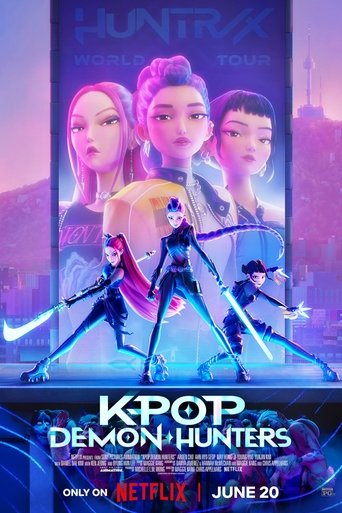
KPop Demon Hunters is the latest product of the ongoing partnership between Sony Pictures Animation and Netflix, a collaboration born out of the pandemic that has since become one of the most creatively fruitful and consistent in the animation space. Freed from the pressure of theatrical box office returns, Sony has used this partnership to take bigger swings, and KPop is a prime example: bold in style, loose in tone, and unafraid to blend K-pop spectacle with anime action and supernatural fantasy. It doesn’t quite hit the emotional highs of Pixar or DreamWorks at their best, but it makes up for it with sheer energy, visual invention, and personality.
Co-directed by Korean-American filmmaker Maggie Kang, the film follows Huntr/x, a globally famous K-pop girl group who moonlight as demon hunters. The animation is vibrant and playful, borrowing Spider-Verse flourishes and Mitchells vs. the Machines-style absurdity, but it’s grounded in Korean iconography and mythology that give it a distinct identity.
The first half is especially strong. It quickly introduces the trio, Rumi, Mira, and Zoey, with clear roles and personalities, and sets up their rivals, the Saja Boys, as both chart-topping competitors and literal demonic threats. The music in this stretch is also at its best, with tracks like the addictive “Golden,” the high-energy “Takedown,” and the bubbly “Soda Pop” standing out. Combined with sharp pacing, even familiar tropes like the rival band dynamic (think Pitch Perfect or even Alvin and the Chipmunks) and the protagonist’s inner conflict, following the now-familiar arc popularized by Elsa in Frozen, still feel fresh and effective.
At the same time, the film builds its most grounded emotional thread through Rumi’s relationship with Jinu, the Saja Boys’ leader. Both characters are carrying personal scars, and the film takes its time developing their bond, lending their dynamic a surprising amount of depth. Their scenes together are some of the most affecting in the film, offering moments of quiet vulnerability amidst the high-energy chaos. Surrounding them, the story also finds room to smartly poke fun at fandom culture, especially how quickly public opinion can shift, how idols are built up and torn down, and how absurdly disposable it all is.
But as the story moves into its final act, some of that early momentum slips. Rumi is pushed to the background, and the emotional connection between the bandmates never fully clicks. Mira and Zoey remain underdeveloped, and the climactic song lacks the punch and memorability of the earlier tracks.
Still, the animation remains consistently striking. It’s full of clever visual gags, like a flexing muscle appearing in someone’s eye, and the blend of Western and Eastern styles generally works well. The only notable mismatch comes during the slower ballads, where the restrained character animation doesn’t quite match the glossy, heavily produced vocal tracks.
It’s easy to compare KPop Demon Hunters with Pixar’s Turning Red, another Asian-American coming-of-age story. While Turning Red follows Pixar’s polished emotional formula, effective, but familiar, KPop is messier, louder, and far more willing to play with tone, genre, and style. It may not fully stick the landing, but I’ll take an ambitious swing like this over a safe, calculated film any day.
Still courtesy of Netflix
- 1Sentimental Value
- 2Hamnet
- 3One Battle After Another
- 4Ne Zha 2
- 5Blue Moon
- 77KPop Demon Hunters#77 of 256
- Where to watch
 Netflix
- Where to watch
- Netflix
 Play trailer


- Original title
- KPop Demon Hunters
- Director
- Maggie Kang, Chris Appelhans
- Cast
- Arden Cho, May Hong, Ji-young Yoo, Ahn Hyo-seop, Yunjin Kim, Ken Jeong, Lee Byung-hun, Daniel Dae Kim
- Rated
- PG
- Screenwriter
- Maggie Kang, Danya Jimenez, Hannah McMechan, Chris Appelhans, Ryan Savas, Bridget Underwood, Alex Chiu, D. Nagisa Koyama, Stephen P. Neary, Ray Xu, Jed Diffenderfer, Jessie Wong, Alicia Chan, Andrew Ross, Sooyeon Lee, Hye Lynn Park, Jessica Kaori Stanley, Radford Sechrist, Christina Chang, Hanna Cho, Darren Webb, Jerod Chirico, Micaela Anita Hammond, Sharon Kikinis, Josh Lieberman, Guillermo Martinez, Wynton Redmond, John Puglisi, Lauren Sassen, Denise Koyama, Andrew James Ross
- Composer
- Marcelo Zarvos
- Editor
- Nathan Schauf
- Country

- Language
- English
- Budget
- $100 million
- Box office
- $24.62 million
- Distributor (CA)
- Netflix