
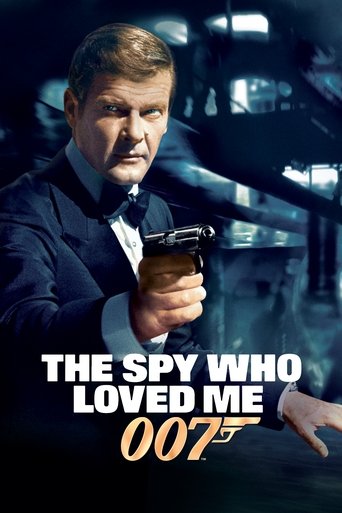

After two misfires in a row, The Spy Who Loved Me came at a make-or-break moment for the Bond franchise. The Man with the Golden Gun had underperformed, and with producer Harry Saltzman stepping away, Albert Broccoli was left steering the ship alone. The team chose Ian Fleming’s novel The Spy Who Loved Me, but since only the title rights had been sold, the writers had to start from scratch. In a way, that gave them the freedom to build a story around Roger Moore’s strengths. And it worked. There are no more attempts to go dark and weird, like in Moore’s previous outing—which clashed awkwardly with the series’ sillier instincts—and for the first time, Moore truly feels settled in the role. The film knows exactly how to frame him: suave, unbothered, and full of self-aware charm. For fans of Moore’s take on Bond, this film often ranks as a favorite.
Where the film really stands out—especially compared to earlier and even later Moore entries—is in its production values. Nearly doubling the budget of The Man with the Golden Gun, every dollar is up on the screen. International location shoots, a massive custom-built set for the supertanker, extensive use of miniatures, and ambitious stunt work—including the iconic ski jump with the Union Jack parachute—give the film a sense of scale and ambition that turns it into an event movie. Bond is treated here as an icon again. It was the most expensive Bond ever made at the time, and also the most financially successful. The film earned Oscar nominations for Best Production Design (well-deserved), Best Original Song (also deserved), and Best Original Score (less so).
Yet for all that confidence, I’ve never really felt much while watching it. The cheeky humor and famous sequences are there, but the film feels oddly devoid of suspense—the kind that elevates the best entries in the series. I never once feared for Bond’s life, and Stromberg’s underwater utopia scheme feels tired and far too far-fetched to take seriously. There are gestures toward deeper character drama—like the mention of Bond’s late wife or the reveal that he killed Agent XXX’s partner—but these are dropped almost as quickly as they’re introduced. Even the dynamic between Bond and XXX doesn’t quite land for me; their chemistry never fully clicks. And while Marvin Hamlisch’s score has its moments (I do like the early “ascent” cue at the station), it often feels awkwardly placed or completely absent when the film needs it most. It still strikes me as ironic that Hamlisch and Thomas Newman were both nominated for their scores, while John Barry and David Arnold—the composers who actually defined the Bond sound—never received that same recognition.
I understand why people look back on this one with such affection: the submarine car, the metal-mouthed Jaws, the parachute stunt. These are great, undeniably fun moments. But as a full film, The Spy Who Loved Me doesn’t hold up as well as the tighter, more grounded entries like From Russia with Love, Goldfinger, or even Gilbert’s own You Only Live Twice, which were made on smaller budgets and still feel more engaging today. This was a necessary course correction for the series, one that finally cemented Moore’s portrayal of Bond and gave us a classic theme song. But for me, it remains a middling Bond—one that plays better in memory than it does while actually watching. It’s slick, yes—but also distant, and more often than not, a little bland. Some do it better.
- 1Sorcerer
- 2Annie Hall
- 3The Ascent
- 4Star Wars
- 5Close Encounters of the Third Kind
- 18The Spy Who Loved Me#18 of 40
- Where to watch
 Prime Video
 Crave
Crave- Where to watch
- Prime Video
 Play trailer


- Original title
- The Spy Who Loved Me
- Director
- Lewis Gilbert
- Cast
- Roger Moore, Barbara Bach, Curd Jürgens, Richard Kiel, Caroline Munro, Walter Gotell, Geoffrey Keen, Bernard Lee
- Rated
- PG
- Screenwriter
- Richard Maibaum, Christopher Wood
- Composer
- Marvin Hamlisch
- Cinematography
- Claude Renoir
- Editor
- John Glen
- Country

- Language
- English
- Budget
- $13.5 million
- Box office
- $185.439 million