
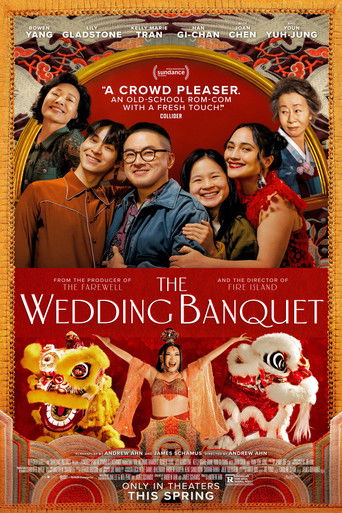
Between The Wedding Banquet and Fire Island, Andrew Ahn has cemented himself as one of the finest directors of romantic comedies in recent years. His films are both deeply personal and universally relatable, showcasing a remarkable balance of humor and heart. Ahn understands that well-rounded characters are the key to a successful rom-com, something many filmmakers overlook. While The Wedding Banquet boasts a fantastic ensemble cast, what truly makes it special is the care Ahn puts into ensuring each character feels like a fully realized person.
This remake of Ang Lee’s 1993 classic successfully reimagines the story for 2025 audiences. In an era where simply hiding a gay relationship wouldn’t be enough to drive the drama, Ahn, alongside the original film’s screenwriter James Schamus, updates the premise in a way that reflects his own culture and voice. The original followed a closeted Taiwanese man in New York who staged a marriage of convenience to appease his traditional parents. Here, the story shifts to Seattle, centering on Min (Han Gi-chan), a Korean man living in the U.S., whose proposal to his boyfriend Chris (Bowen Yang) is declined. To secure his stay in the U.S., Min enters a fake marriage with his roommate Angela (Kelly Marie Tran), who, along with her partner Lee (Lily Gladstone), is looking to fund another IVF treatment after a previous failure. Complications arise when Min’s grandmother arrives from Korea, expecting a traditional wedding, forcing everyone to keep up the charade.
One of the film’s greatest strengths is its commitment to keeping everything character-driven, especially its conflicts. It’s refreshing to watch a rom-com without contrived drama, everything here feels organic, stemming naturally from the characters’ emotions and circumstances. There are no villains, no cheap misunderstandings, and no forced betrayals. The film trusts its audience to empathize with everyone, making even the most frustrating moments feel genuine rather than manufactured. Ahn’s handling of Chris (Bowen Yang) is particularly impressive; in lesser hands, his insecurities could have been grating, but here, they feel entirely natural and deeply human.
Beyond the writing, the cast is excellent, bringing warmth and chemistry that makes the relationships feel lived-in. The core four have an effortless dynamic, and it’s one of those rare cases where no single performer stands out because they all create space for each other to shine. While the leads are fantastic, two remarkable supporting performances elevate the film even further. Joan Chen shifts from last year’s dramatic roles to broad comedy as Angela’s overbearing but well-meaning mother, while Youn Yuh-jung adds gravitas and humor in equal measure as Min’s grandmother. Both deliver plenty of laughs, but they also bring weight to their dramatic moments, making them feel just as essential to the emotional core of the story.
The film is an easygoing, breezy delight, packed with well-thought-out jokes and endearing characters. It knows exactly when to be gentle and touching, making you root for these people to find happiness. It comes close to being a 4.5-star film, perhaps missing one truly showstopping comedic set piece (was the Korean wedding sequence meant to be that moment?) or a slightly bigger emotional climax in the third act, perhaps involving Min’s grandfather, that could have pushed it over the edge. But even with those minor nitpicks, The Wedding Banquet is a hilarious, perfectly cast, and deeply satisfying rom-com that proves Andrew Ahn is a true master of blending heart and humor.
- 1Sentimental Value
- 2Hamnet
- 3One Battle After Another
- 4Ne Zha 2
- 5Blue Moon
- 23The Wedding Banquet#23 of 256
- 1Kiss of the Spider Woman
- 2The Ballad of Wallis Island
- 3The Wedding Banquet#3 of 27
- 4Together
- 5Twinless
- Where to watch
 Crave
Crave- Where to watch
- Rent or buy at Apple TV Store, Amazon Video
 Play trailer


- Original title
- The Wedding Banquet
- Director
- Andrew Ahn
- Cast
- Bowen Yang, Lily Gladstone, Kelly Marie Tran, Han Gi-chan, Joan Chen, Youn Yuh-jung, Bobo Le, Camille Atebe
- Rated
- R
- Screenwriter
- James Schamus, Andrew Ahn, Ang Lee, Neil Peng
- Composer
- Jay Wadley
- Cinematography
- Ki Jin Kim
- Editor
- Geraud Brisson
- Country

- Language
- English
- Budget
- $5 million
- Box office
- $2.075 million