
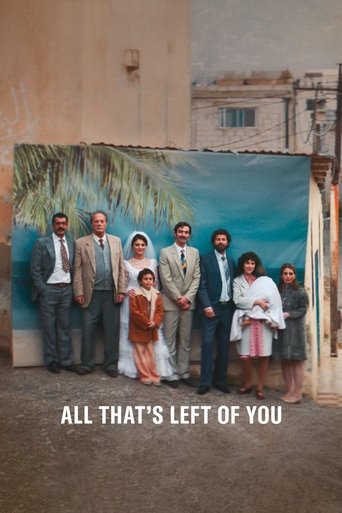
At the heart of All That’s Left of You lies a decision so profound that the film rewinds decades to unpack its consequences fully. It’s a choice so complex and weighty that it demands more than just a well-crafted narrative. While the film succeeds in providing the necessary historical context, it falls short of fully immersing us in the emotional depth of its themes.
The film opens with a young Palestinian teenager on what should be an ordinary day. In a sequence that vividly establishes the rhythms of his city, he unexpectedly becomes entangled in a protest, culminating in a violent clash with Israeli soldiers. Years later, his mother recounts how he arrived at that moment, a story that stretches back 75 years to his grandfather. From there, All That’s Left of You takes an ambitious approach, spanning three generations of this Palestinian family and chronicling their struggles and resilience, culminating in that fateful decision that defines the film.
One of the film’s greatest strengths is how it frames this family’s evolution against the backdrop of Palestine’s changing landscape. The city where the grandfather, Sharif (Adam Bakri), once lived becomes a character in its own right. The narrative unfolds through time jumps, pausing at crucial moments, with the first act standing out as the most compelling. In it, Sharif, a citrus farmer in Jaffa, desperately tries to hold onto his land amidst the Nakba of 1948. (For those unfamiliar, the Nakba was the mass displacement of Palestinians following the creation of the State of Israel.) His imprisonment and forced displacement weigh heavily on him, losing something passed down through generations is, to him, the ultimate injustice. That frustration and remorse ripple through the family, shaping his grandson’s life decades later.
The first hour excels at contextualizing both the family’s personal struggles and the historical forces shaping them, seamlessly blending intimate moments with the broader political reality. The most striking sequences are those in which daily life is interrupted, simple family games shattered by external forces. Like the recent Brazilian film I’m Still Here, the impact of historical trauma is felt most viscerally when we first see what normalcy looks like before it’s violently stripped away.
The weight of these early events lingers, both for the film and the family, but as the story progresses, it shifts from an expansive historical drama to something more intimate. Thematically, this transition makes sense, what begins as a sweeping historical narrative naturally narrows into personal consequences, but the execution falters. Once the focus tightens, the direction, performances, and writing must sustain the film’s emotional weight, and this is where All That’s Left of You struggles.
Palestinian director Cherien Dabis takes on the roles of director, writer, and actress, crafting a story with deep emotional potential. Yet, its impact doesn’t always fully resonate with her vision. On paper, the film is affecting, and the production elements, the lived-in locations (shot in Cyprus), meticulous production design, and Amine Bouhafa’s evocative score, help immerse the audience. Some moments, like a father and son’s tense encounter with Israeli soldiers, effectively retain their emotional charge. However, key scenes, such as a conversation with an Imam and the pivotal discussion that frames the entire film, lack truly memorable dialogue. The direction doesn’t always elevate these moments, and the performances sometimes miss the nuance needed to convey the film’s most profound themes fully. As a result, the later acts, despite featuring the most dramatic events, feel slower and less engaging, as the emotional weight gradually diminishes.
There’s also a disconnect between the intergenerational story and the film’s central relationship, the couple at the core of the main decision. While the film effectively traces how the boy arrives at that moment, his parents feel strangely removed from the weight of history. The mother’s perspective is underdeveloped, as we rarely see her reckon with her husband’s or father-in-law’s past, leaving her role feeling passive in a story shaped by generational struggle. Meanwhile, the husband himself seems largely unaffected by his family’s long history of displacement, making his character feel underwritten. This emotional distance weakens the film’s attempt to bridge past and present, and even the epilogue, intended to bring the story full circle, doesn’t carry the emotional weight it strives for.
All That’s Left of You offers plenty to reflect on with its powerful subject matter, but its execution turns a story that should devastate and leave an unshakable impression into something frustratingly conventional.
- 1Sentimental Value
- 2Hamnet
- 3One Battle After Another
- 4Ne Zha 2
- 5Blue Moon
- 121All That's Left of You#121 of 256
- 1Kiss of the Spider Woman
- 2The Ballad of Wallis Island
- 3The Wedding Banquet
- 4Together
- 5Twinless
- 14All That's Left of You#14 of 27
- Where to watch
- Rent or buy at Apple TV Store, Amazon Video
- Where to watch
- Not available for streaming
 Play trailer


- Original title
- اللي باقي منك
- Director
- Cherien Dabis
- Genre
- Drama
- Cast
- Saleh Bakri, Cherien Dabis, Adam Bakri, Maria Zreik, Mohammad Bakri, Muhammad Abed Elrahman, Sanad Alkabareti, Salah Al Din
- Rated
- NR
- Screenwriter
- Cherien Dabis
- Composer
- Amine Bouhafa
- Cinematography
- Christopher Aoun
- Editor
- Tina Baz
- Country




- Language
- Arabic
- Box office
- 276431