
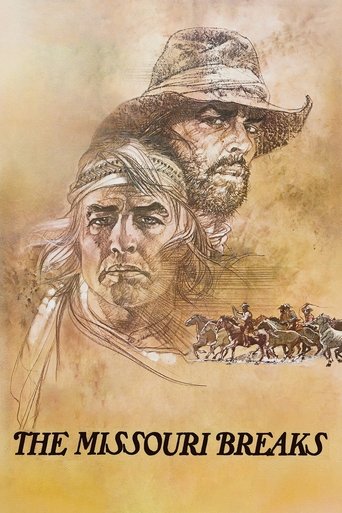
The Missouri Breaks had the kind of poster that sold itself: Jack Nicholson and Marlon Brando, side by side, with the ominous tagline, “One Steals. One Kills. One Dies.” In 1976, it was the Western equivalent of pitting Captain America against Iron Man, two of the biggest stars of the decade facing off, with nothing held back. Hype was through the roof. Nicholson was riding high off Chinatown and his Oscar win for One Flew Over the Cuckoo’s Nest. Brando was returning to the screen after redefining modern acting in The Godfather and Last Tango in Paris. Behind the camera? Arthur Penn, the director of Bonnie and Clyde and Night Moves. And scoring it all? John Williams, fresh off his Oscar win for Jaws. On paper, how could this miss?
The answer is: it doesn’t exactly miss, it just never becomes the movie it should’ve been. Instead, it ends up an odd patchwork of tones and ideas, stitched together without much cohesion. It’s a film where three wildly different visions seem to be competing at once, sometimes within the same scene. You can feel Penn’s uncertainty behind the camera, unsure whether to make a revisionist Western, a dark comedy, or a stylized character study.
In one corner, you have Nicholson, playing things surprisingly straight as Tom Logan, a horse thief in a morally complex world. This side of the film, the grounded, gritty Western, works best. It fits neatly into the ’70s wave of revisionist takes on the genre, where heroes were flawed and the line between right and wrong was blurred. Nicholson plays it with restraint, and though his romantic subplot with Kathleen Lloyd’s Jane Braxton adds little beyond a soft emotional beat, it doesn’t distract too much.
Then there’s the score, which feels like it belongs in a different movie entirely. Williams, usually the GOAT, goes for a quirky, whimsical sound here, pushing sequences like the train robbery into near-slapstick territory. It’s a baffling mismatch. Instead of heightening tension, the music undercuts it, making moments that should feel dangerous seem goofy instead. It’s one of the rare times Williams’ score actively works against the film.
And then, of course, there’s Brando. His turn as Robert E. Lee Clayton is a performance that feels dropped in from another dimension. Reportedly rewriting much of his own dialogue and improvising freely, Brando delivers something magnetic, bizarre, and totally unhinged. Whether he’s dressing in drag, whispering philosophical threats, or chatting with his horse, Clayton is always unpredictable, equal parts terrifying and ridiculous. You could draw a line from him to Hans Landa or Anton Chigurh: villains who smile as they twist the knife. The problem is, Brando’s performance belongs in a film that knows what to do with it. Here, it plays like a solo act in a band that’s trying to keep a straight face.
That imbalance ends up defining The Missouri Breaks. Penn, by all accounts, let Brando run wild while focusing on Nicholson’s more measured arc. It results in a film that is constantly at odds with itself. There are flashes of brilliance, moments of tension, and performances worth watching, but they never come together into something greater. It’s a strange, lopsided Western that’s more fascinating as a curiosity than a success.
- Where to watch
 Prime Video
- Where to watch
- Prime Video
 Play trailer


- Original title
- The Missouri Breaks
- Director
- Arthur Penn
- Cast
- Marlon Brando, Jack Nicholson, Randy Quaid, Kathleen Lloyd, Frederic Forrest, Harry Dean Stanton, John McLiam, John P. Ryan
- Rated
- R
- Screenwriter
- Thomas McGuane
- Composer
- John Williams
- Cinematography
- Michael C. Butler
- Editor
- Dede Allen, Gerald B. Greenberg, Stephen A. Rotter
- Country

- Language
- English
- Budget
- $10 million
- Box office
- $14 million