
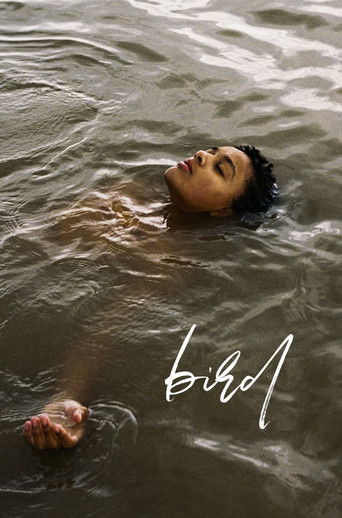
Andrea Arnold’s Bird starts with immense potential, introducing Bailey (Nykiya Adams), a 12-year-old girl caught in a difficult situation, and her father Bug (Barry Keoghan), a devoted yet emotionally immature man. The film delves into themes of childhood stripped away too soon, as Bailey navigates an unstable home life. Arnold effectively places the audience in Bailey’s shoes, highlighting her inner turmoil through a haunting mix of modern electronic beats and dissonant voices in the score. Adams gives a breakout performance, showcasing a balance of maturity and vulnerability, and Keoghan’s portrayal of a man-child father adds depth to his character’s struggles.
The film is particularly effective at juxtaposing Bailey’s childhood with her forced maturity. Arnold consistently reminds us that, despite Bailey’s resilience, she is still just a young girl navigating the onset of her first period. Moments such as the scene where Bailey and her friends plot a scheme, only for the camera to linger on a distant amusement park, beautifully illustrating what the children should also be doing. Bug, her father, mirrors this arrested development, as he clumsily tries to rebuild his life, that will probably result in another child.
However, Bird stumbles when it introduces its titular character Bird, a subplot that feels unnecessary and detracts from the film’s otherwise rich family dynamics. While Bird’s journey is intended to mirror Bailey’s, it feels repetitive and, frankly, irritating. The mystical elements surrounding Bird also clash with the film’s otherwise grounded and realistic tone. The focus on this subplot takes away from more interesting aspects of the story, like Bailey’s siblings and her strained relationship with her mother. Even Bug’s arc becomes sidelined, missing opportunities for deeper exploration of his flaws and the generational cycle he may be perpetuating.
The film’s constant use of shaky camera exacerbates these frustrations, making certain scenes disorienting and, at times, nauseating. While the chaotic cinematography might be intended to reflect the instability of Bailey’s world, it often feels excessive, distracting from the emotional core of the story.
Bird has the bones of a great film, with moments of humor, raw emotion, and poignant family drama. However, its unnecessary subplot and stylistic missteps prevent it from reaching its full potential. Despite this, Arnold’s empathetic direction and strong performances still make it a film worth watching, even if it falls short of her best work.
Still courtesy of MUBI
- 1Dune: Part Two
- 2Conclave
- 3Better Man
- 4The Substance
- 5Challengers
- 40Bird#40 of 110
- 1Conclave
- 2Better Man
- 3The Substance
- 4The Assessment
- 5Queer
- 17Bird#17 of 50
- Where to watch
 Mubi
Mubi- Where to watch
- Mubi
 Play trailer


- Original title
- Bird
- Director
- Andrea Arnold
- Genre
- Drama
- Cast
- Nykiya Adams, Franz Rogowski, Barry Keoghan, Jason Buda, Jasmine Jobson, Frankie Box, James Nelson-Joyce, Jason Williamson
- Rated
- R
- Screenwriter
- Andrea Arnold
- Composer
- Burial
- Cinematography
- Robbie Ryan
- Editor
- Joe Bini
- Country


- Language
- English
- Box office
- $1.945 million
- Distributor (CA)
- MUBI