
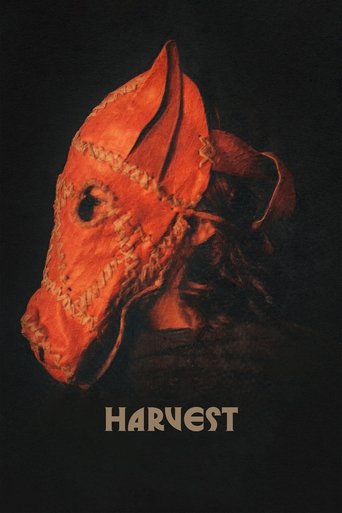
Harvest is a difficult film to pin down. A thoughtful study of a village collapsing under the weight of capitalism and xenophobia, it draws strength from striking artistic choices: casting locals in supporting roles for authenticity, shooting on textured 16mm that captures the Scottish Highlands with rustic beauty, and a deeply committed performance from the always-reliable Caleb Landry Jones. The film carries a contemplative rhythm, at times evoking the ambition of a lost Terrence Malick masterpiece. Yet for all its individual strengths, the film remain scattered, never merging into a fully satisfying whole. The ideas and approaches often pull against each other, leaving a work that falls into that classic easier-to-admire-than-to-truly-connect-with bucket.
The story unfolds across seven days in a village owned by Charles Kent (Harry Melling), a spineless laird who inherited the land from his wife. The villagers live carelessly, working by day and partying by night. We open with a raucous celebration where they recklessly set part of their territory on fire, only to receive a laughable warning from their lord, who can’t even look them in the eye while doing so, scared to face their reaction. Watching all this through an introspective lens is Walter Thirsk, an outsider tied to Master Charles, and seemingly the only sane man in sight. The routine quickly shifts when three wandering strangers are blamed for the fire, and when a cartographer arrives to map the land, a sign of an inevitable privatization, pushed by Charles’s ambitious cousin Edmund.
The village becomes a microcosm for larger realities. The film illustrates how societies scapegoat outsiders, how ambition in power corrodes families and communities, how dangerous ineffectual leaders can be, and how mob mentality hardens into action. What works best is how these themes emerge without speechifying. Scenes like Edmund unceremoniously stating that there will be needed work cuts, and by consequence, separation and desertion of workers, or the villagers reaching a very fast consensus while judging the outsiders, capture the ideas with effective ease, as if all were unavoidable traces of human nature, which only Thirsk is able to realize what they actually mean. But that’s where the intelligence in its approach ends, as if director Athina Rachel Tsangari is very content with stating her point of view, and doesn’t really care for us to feel any of the tragedy of its consequences.
She adopts a Terrence Malick-like style that is very logical to the material, but often makes use of it in the wrong moments. Scenes that call for urgency and tension are treated with quiet contemplation. The pacing slows when it should escalate, and we never feel that the passage of time in its seven days is occurring, nor that conflicts are building toward tragedy and its inevitability. When tragedy finally arrives, it comes with little emotional backing, and in an effort to overcompensate, Tsangari stages overblown scenes that border on laughable. Never is this more evident than in two different sequences, both containing women physically overpowering men, staged so clumsily that they tip into absurdity and unintentional comedy.
A similar tonal imbalance extends to the performances. Too often it is not even clear what the director wants us to know about her characters’ thoughts, and by extension, why they act as they do, making a lot of the film lifeless and confusing. Harry Melling feels very out of his depth and constantly overacts with exaggerated mannerisms, made worse by the script that wastes his character, as if it is constantly hinting at a climax scene that never comes. Some villagers follow Melling’s approach and lean into caricature, which clashes with Caleb Landry Jones’s far more grounded approach. At times, during the same scene, a singular conversation has characters reacting as if they are in different movies (an early interaction between Thirsk and an aroused woman). Landry Jones’ introverted performance is very strong in isolation, and it is fascinating to see the choices he incorporates into the material, from the way he carries himself to his looks that always reflect what the character is thinking. Yet the approach doesn’t generate the spark of engagement that the first act so badly needed. Think of Gérard Depardieu’s similar performance in 1900, and you can clearly see what was missing.
The most frustrating part of Harvest is that it has the skeleton of a great film. The perspective is clear, the script often sharp, and the cinematography truly striking. It should have been a winner. Yet I kept thinking of other films with similar themes (1900, The Promised Land), admittedly much bigger in scope, that never forgot to ground their themes with humans at the center. Those works resonate far longer than Harvest will. Aside, of course, from the hideous shot of Caleb’s red-haired ass that opens the film. That one, unfortunately, is hard to forget.
Still courtesy of MUBI
- 1Sentimental Value
- 2Hamnet
- 3One Battle After Another
- 4Ne Zha 2
- 5Blue Moon
- 205Harvest#205 of 256
- 1Conclave
- 2Better Man
- 3The Substance
- 4The Assessment
- 5Queer
- 38Harvest#38 of 50
- Where to watch
 Mubi
- Where to watch
- Mubi
 Play trailer


- Original title
- Harvest
- Director
- Athina Rachel Tsangari
- Genre
- Drama
- Cast
- Caleb Landry Jones, Harry Melling, Rosy McEwen, Arinzé Kene, Thalissa Teixeira, Frank Dillane, Stephen McMillan, Mitchell Robertson
- Rated
- R
- Screenwriter
- Athina Rachel Tsangari, Joslyn Barnes
- Composer
- Caleb Landry Jones, Nicolas Becker, Ian Hassett
- Cinematography
- Sean Price Williams
- Editor
- Matthew Johnson, Nico Leunen
- Country


- Language
- English
- Distributor (CA)
- MUBI