
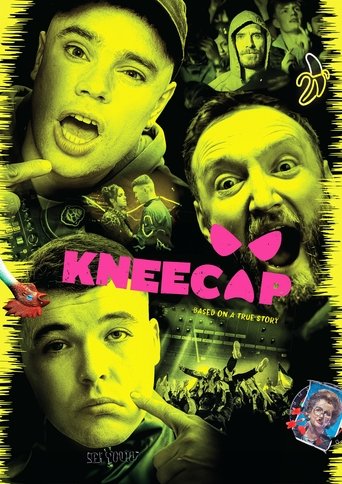
Only 10% of the Irish population describes themselves as being able to speak Irish very well. Efforts to preserve the language are ongoing, and while there has been an increase in the ability to speak Irish over the past five years, its daily usage has been steadily declining, largely due to globalization. Kneecap is a comedy-drama that chronicles the rise of a real Belfast-based hip-hop trio using their music to celebrate and revitalize the language. The real-life trio play themselves.
The film follows the formation of the band and their motivations, borrowing stylistically from Danny Boyle (Trainspotting), Guy Ritchie (Lock, Stock and Two Smoking Barrels), and John Carney (Once), while also channeling the socially charged energy of European protest films like Pride and BPM. The result is breezy and entertaining throughout.
The trio’s formation, comprising two brothers and an Irish teacher, is explored in the first act, which contains some of the film’s best moments. Fun, fast-paced montages depict their first drug experiences, accompanied by Rich Peppiatt’s lively direction, which incorporates animated effects, quick cuts, and inventive visual flourishes. It’s not particularly original, but it’s undeniably entertaining. As the story progresses, the film tones down its flashy style to focus more on the narrative, though it retains clever ideas and humorous moments. Standout scenes include a menacing staircase confrontation with the antagonist detective, framed like a James Bond villain, and a hilarious funeral sequence where the camera and narration hilariously categorize the various attendees.
Among the trio, DJ Provai (the Irish DJ) emerges as the most compelling character, with a satisfying arc that culminates in a memorable school board interrogation scene. However, while the trio brings authenticity to their roles, they lack the charisma needed to fully carry a film, unlike the dynamic Lonely Island crew in Popstar: Never Stop Never Stopping. Additionally, the antagonist’s motivations feel underdeveloped, as the film doesn’t offer much insight into her perspective. Exploring why she is so determined to suppress the resurgence of the Irish language would have been greatly beneficial to the story.
The parents, played by Simone Kirby and Michael Fassbender, fare better and deliver the film’s most emotional scene. Fassbender’s performance is a particular treat, as he leans into his Irish accent and brings an intensity reminiscent of his Magneto days in the X-Men franchise.
While Kneecap may not fully resonate with audiences who aren’t drawn to hip-hop culture, it entertains and succeeds in educating viewers about the Irish language and its cultural significance. I’ll admit, I didn’t even know Irish was a language before watching this film, but I walked away genuinely cheering for its preservation. In that sense, Kneecap achieves its mission, shattering the glass box of obscurity and letting the dodo take flight once more.
- Where to watch
 Crave
Crave- Where to watch
 Prime Video
 Play trailer


- Original title
- Kneecap
- Director
- Rich Peppiatt
- Cast
- Móglaí Bap, Mo Chara, DJ Próvaí, Josie Walker, Fionnuala Flaherty, Jessica Reynolds, Adam Best, Simone Kirby
- Rated
- R
- Screenwriter
- Rich Peppiatt, Móglaí Bap, Mo Chara, DJ Próvaí, Jack Wright
- Composer
- Michael Asante
- Cinematography
- Ryan Kernaghan, Conor Rotherham
- Editor
- Julian Ulrichs, Chris Gill
- Country



- Language
- Irish
- Box office
- $4.345 million
- Distributor (CA)
- Mongrel Media